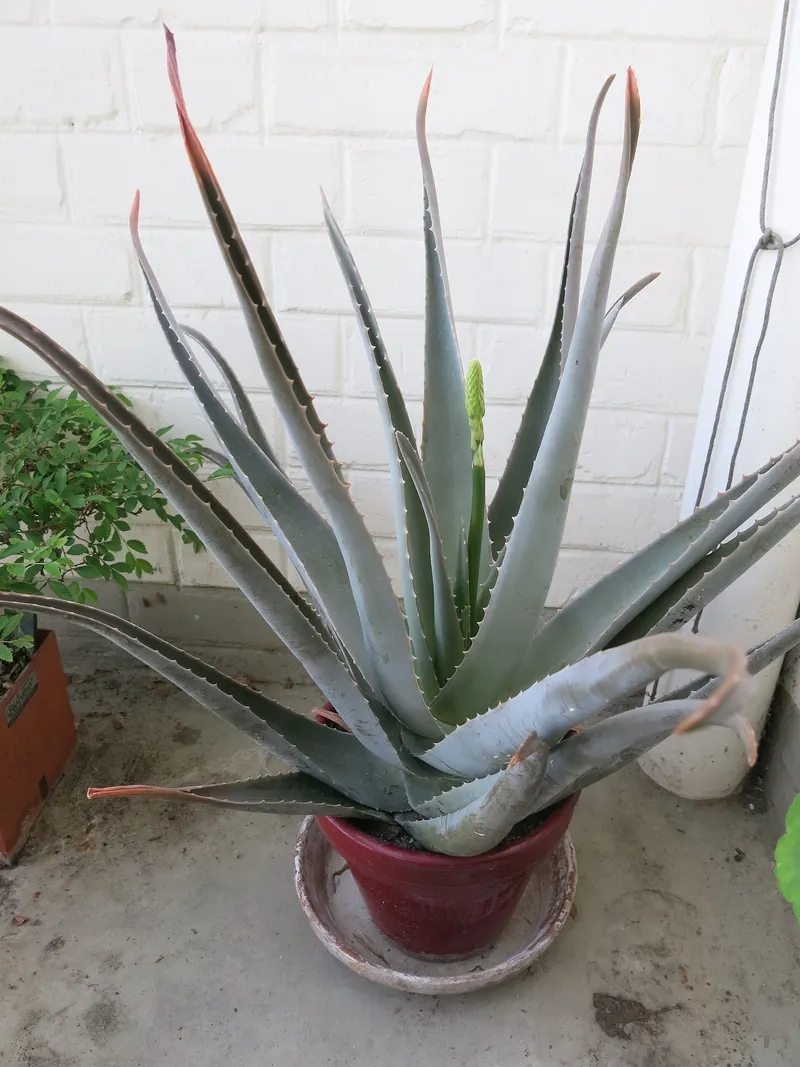
What it does for you
Aloe vera is a succulent: it stores a clear gel in its thick leaves1. People have used it as a medicinal plant for thousands of years – the Egyptians, Greeks, Romans, Indians and Chinese all knew it2. And it's considered one of the easiest plants of all to grow2, as long as it gets enough sun3.
Origin & history
True Aloe vera only grows wild in the Hajar Mountains in northern Oman, in deserts and dry scrubland5 (older sources say Africa2). Because it is so easy to transplant and has been used medicinally for over 6,000 years, its exact origin was unclear for a long time2.
Today it is naturalised in more than 70 countries and regions5. The Spanish brought it to South America and the Caribbean2.
Caution
The gel is considered edible, but the leaves contain saponins and anthraquinones: cats and dogs may vomit, become lethargic and get diarrhoea6. In humans the latex causes stomach cramps and diarrhoea, and it irritates the skin1. So keep it out of reach of pets and children and wear gloves when repotting7.
Care
Light. Full sun, ideally right at a south- or west-facing window (southern hemisphere: north or west)2. In shade it doesn't grow well3. In summer it can go outside – get it used to full sun slowly.
Water. Let the soil dry out completely between waterings1, then water thoroughly2. In winter only very sparingly7. Constantly wet soil makes the roots rot1.
Temperature & humidity. Normal room temperature is fine. It can't take frost – ideally keep it above 10 °C; the RHS gives 5–10 °C as its minimum7. It dislikes humid air3, so dry, heated air suits it.
Soil, pot & repotting. Peat-free cactus soil7 in a pot with a large drainage hole2 – clay is ideal1. As a rule of thumb, repot every two to three years, once the offsets fill the pot.
Feeding. From late spring to late summer once a month with liquid fertiliser7.
Extras
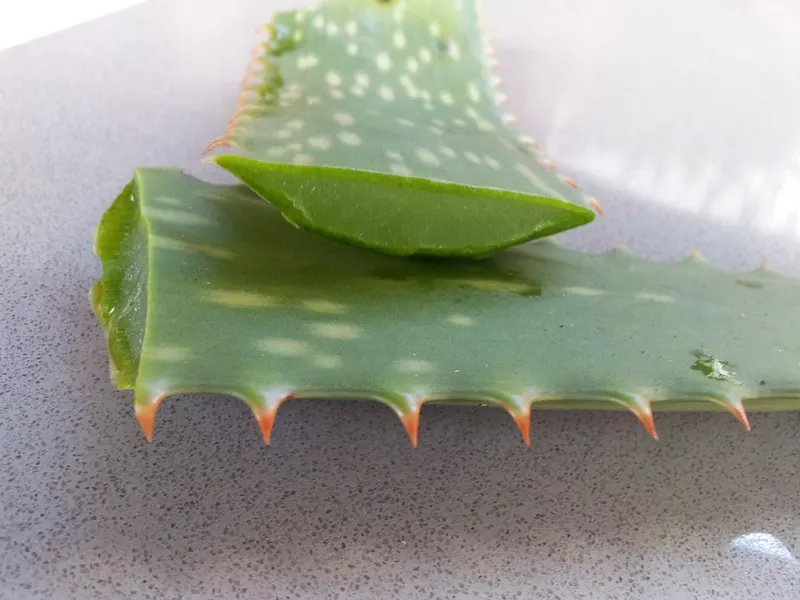
Its flowers are borne on stalks up to 90 cm long, with greenish-yellow tubular flowers7. For the gel: cut off a mature leaf, slice it open and spread the gel or sap onto a minor burn4 or an insect bite2.

Symptoms & help
| too little | too much | |||
|---|---|---|---|---|
| Water | Leaves wilt. → Water thoroughly, then let the soil dry out completely before the next watering. | Leaves turn yellowish and wilt, the roots rot. → Take it out of the pot, cut away rotten parts, replant in fresh cactus soil and keep it moderately dry. | ||
| Light | Growth gets weak, thin and soft, the leaves pale, new leaves small. → Move it to the sunniest window, get it used to more sun slowly. | Leaves turn yellowish or get spots, especially after a sudden move into full sun. → Get it used to the sun gradually. | ||
| Fertiliser | Brown, dry leaf tips, white crusts on the soil. → Flush the soil thoroughly with water several times, then feed less. | |||
| Warmth | Leaves wilt and bend down – after frost or a cold night outdoors. → Bring it somewhere warm (above 10 °C) right away, cut off damaged leaves. |
Take it with you
- Plant cardFront and back in A6 landscape – print it and keep it next to the pot
- PDF ↓


Notes on the files: Print & engrave
Licence and attribution for the plant labels: Readme (TXT)
Sources
- NC State Extension: Aloe vera. North Carolina Extension Gardener Plant Toolbox. https://plants.ces.ncsu.edu/plants/aloe-vera/ (accessed 11 October 2026)
- Schalau, J. (2024): Aloe Vera. University of Arizona Cooperative Extension, Backyard Gardener 169. https://extension.arizona.edu/sites/extension.arizona.edu/files/attachment/AloeVera.pdf (accessed 11 October 2026)
- Royal Horticultural Society: Aloe. RHS Plants. https://www.rhs.org.uk/plants/aloe (accessed 11 October 2026)
- National Center for Complementary and Integrative Health (NCCIH) (2025): Aloe Vera. NCCIH Health Topics. https://www.nccih.nih.gov/health/aloe-vera (accessed 11 October 2026)
- Royal Botanic Gardens, Kew: Aloe vera (L.) Burm.f. Plants of the World Online. https://powo.science.kew.org/taxon/urn:lsid:ipni.org:names:530017-1 (accessed 11 October 2026)
- ASPCA Animal Poison Control Center: Aloe (Aloe vera). Toxic and Non-Toxic Plant List. https://www.aspca.org/pet-care/animal-poison-control/toxic-and-non-toxic-plants/aloe (accessed 11 October 2026)
- Royal Horticultural Society: Aloe vera. RHS Plants. https://www.rhs.org.uk/plants/981/aloe-vera/details (accessed 11 October 2026)
- Missouri Botanical Garden: Aloe vera. Plant Finder. https://www.missouribotanicalgarden.org/PlantFinder/PlantFinderDetails.aspx?taxonid=282195 (accessed 12 October 2026)
- Lüttge, U. (2004): Ecophysiology of Crassulacean Acid Metabolism (CAM). Annals of Botany 93, 629–652. doi:10.1093/aob/mch087
- Berger, J., Essah, E. & Blanuša, T. (2024): The impact of plants on the humidity of naturally-ventilated office indoor environments. Journal of Building Engineering 86, 108814. doi:10.1016/j.jobe.2024.108814
- Royal Horticultural Society: How to take cuttings from houseplants. RHS Growing Guide. https://www.rhs.org.uk/plants/types/houseplants/how-to-take-cuttings-from-houseplants (accessed 14 October 2026)
- DelPrince, J. M. & Perry, J. H. (2021): Care & Selection of Indoor Plants. Mississippi State University Extension, Publication 1012. https://extension.msstate.edu/publications/care-selection-indoor-plants (accessed 11 October 2026)