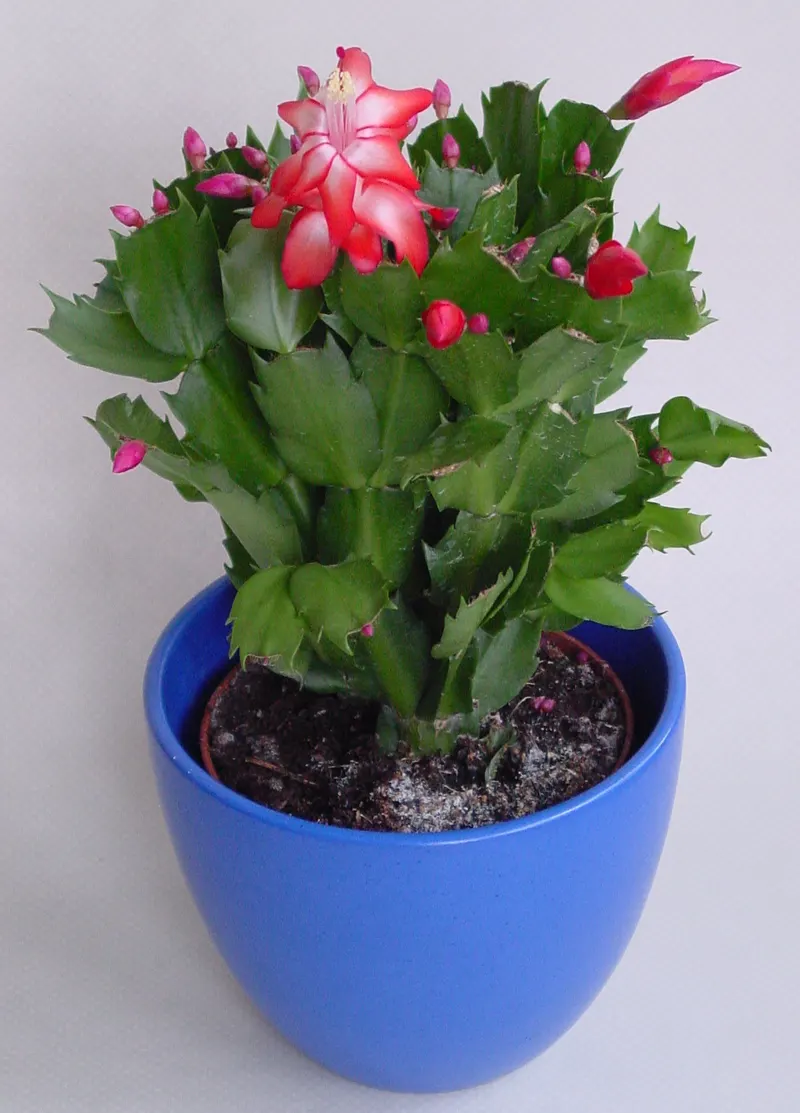
What it does for you
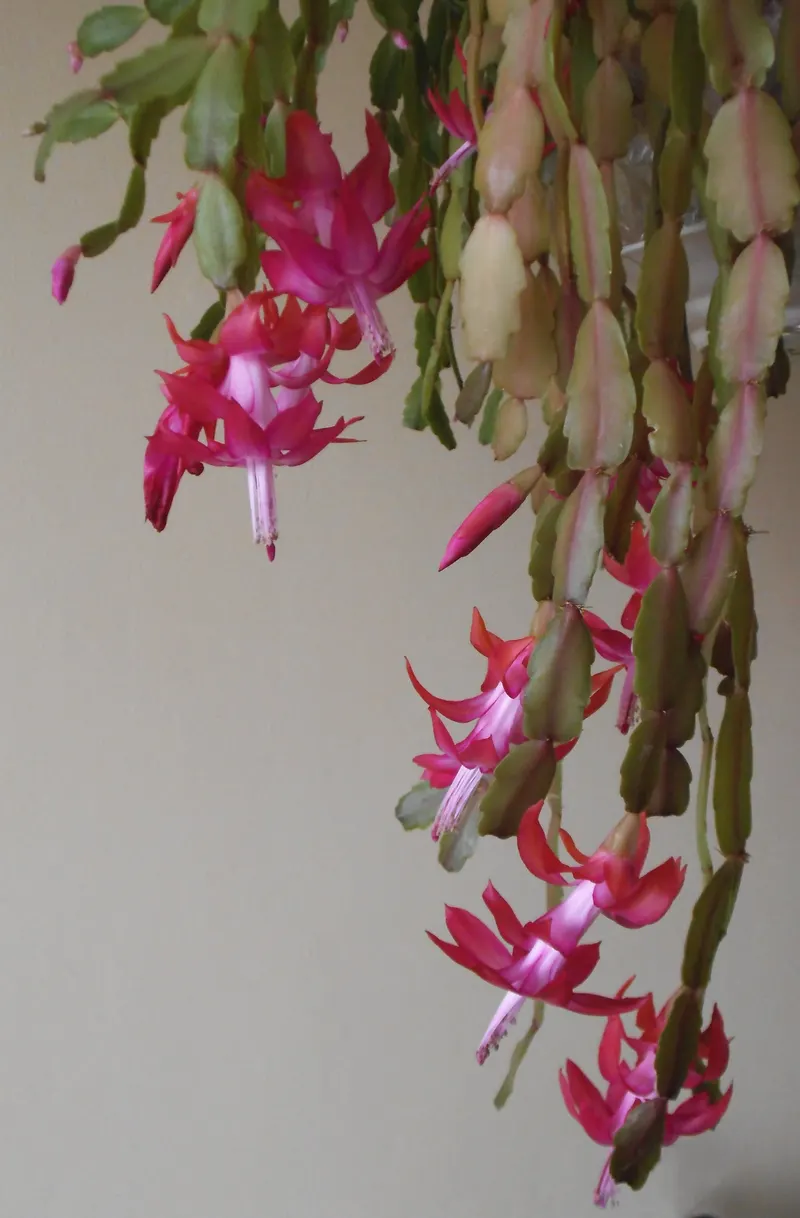
The Christmas cactus flowers when hardly anything else does: from late autumn into midwinter, in red, pink or white1. It's easy to keep and can live to a great age – the more shoots it forms over the years, the more flowers it carries1. And it's non-toxic to people, cats and dogs2,3.
Origin & history
In the wild, the Christmas cactus and its relatives grow only in humid mountain forests of south-eastern Brazil4. There they perch as epiphytes in the forks of tree branches4.
The "true" Christmas cactus, Schlumbergera × buckleyi, is a hybrid that William Buckley bred at an English nursery in the 1840s3. Most plants on sale, though, are S. truncata or its hybrids – recognisable by small pointed teeth on the stem segments instead of rounded notches4. It used to be called Zygocactus truncatus4.
Caution
It isn't toxic to cats and dogs2, and it's considered non-toxic to people as well5,3.
Care
Light. Bright, but not in full sun; a window with morning sun is good1. Harsh sun bleaches the shoots3.
Water. In spring and summer keep it moist but never wet. From early autumn, water more sparingly and let the top few centimetres dry until buds show; then water regularly again until the flowers fade, and rest it again after flowering1.
Temperature & humidity. 18–20 °C in summer, never below 10 °C. It doesn't mind humid air: mist it or stand it on wet gravel1.
Soil, pot & repotting. Cactus soil1. Repot every one to two years in early spring, into a pot only slightly bigger1. Kept a little snug, it flowers more6.
Feeding. Liquid fertiliser from spring to early autumn1, about once a month3.
Extras
It's a short-day plant: it forms buds after about six weeks of long nights – 13 to 16 hours of darkness, depending on the source6,4. So from early autumn, keep it cool at 12–15 °C and away from lamplight in the evening. If it gets warmer than 18 °C, it flowers late or not at all1. Buds drop with fluctuating temperatures, overwatering or too dry soil, or when you move the plant while buds are forming1,4.
It only forms flowers at the shoot tips. For a bushier plant, snap a few end segments off long shoots in spring after flowering – more shoots mean more flowers1.

Symptoms & help
| too little | too much | |||
|---|---|---|---|---|
| Water | Stem segments shrivel, buds drop. → Water thoroughly, pour away the excess. In spring and summer never let the soil dry out completely. | Shoots shrivel despite wet soil, roots rot, buds drop. → Let the soil dry out and don't leave the pot standing in water. | ||
| Light | Stem segments turn pale, discoloured or get scorched patches. → Take it out of the midday sun. | |||
| Warmth | Buds drop, e.g. after the trip home from a cold shop or in a draught. → Keep it evenly bright and cool, but above 10 °C, and don't move it while buds are forming. |
Take it with you
- Plant cardFront and back in A6 landscape – print it and keep it next to the pot
- PDF ↓

Notes on the files: Print & engrave
Licence and attribution for the plant labels: Readme (TXT)
Sources
- Royal Horticultural Society: How to grow Christmas cactus. RHS Growing Guide. https://www.rhs.org.uk/plants/christmas-cactus/growing-guide (accessed 14 October 2026)
- ASPCA Animal Poison Control Center: Christmas Cactus (Schlumbergera bridgesii). Toxic and Non-Toxic Plant List. https://www.aspca.org/pet-care/animal-poison-control/toxic-and-non-toxic-plants/christmas-cactus (accessed 14 October 2026)
- NC State Extension: Schlumbergera x buckleyi. North Carolina Extension Gardener Plant Toolbox. https://plants.ces.ncsu.edu/plants/schlumbergera-x-buckleyi/ (accessed 14 October 2026)
- Jauron, R. & Steil, A.: All About Holiday Cacti. Iowa State University Extension and Outreach, Yard and Garden. https://yardandgarden.extension.iastate.edu/how-to/all-about-holiday-cacti (accessed 14 October 2026)
- University of Nebraska–Lincoln Extension in Lancaster County (2015): Toxicity of Common Houseplants. Horticulture fact sheet 031 (archived copy). https://web.archive.org/web/20241123081117/https://lancaster.unl.edu/hort/factsheets/031_toxicityhouseplants.pdf (accessed 12 October 2026)
- Haag, B. (2024): A Seasonal Favorite: The Beauty of Holiday Cacti in Full Bloom. University of Illinois Extension, Flowers, Fruits, and Frass (blog). https://extension.illinois.edu/blogs/flowers-fruits-and-frass/2024-11-22-seasonal-favorite-beauty-holiday-cacti-full-bloom (accessed 14 October 2026)
- Royal Horticultural Society: Schlumbergera × buckleyi (Christmas cactus). RHS Plants. https://www.rhs.org.uk/plants/23973/schlumbergera-buckleyi/details (accessed 14 October 2026)
- Royal Horticultural Society: How to take cuttings from houseplants. RHS Growing Guide. https://www.rhs.org.uk/plants/types/houseplants/how-to-take-cuttings-from-houseplants (accessed 14 October 2026)
- DelPrince, J. M. & Perry, J. H. (2021): Care & Selection of Indoor Plants. Mississippi State University Extension, Publication 1012. https://extension.msstate.edu/publications/care-selection-indoor-plants (accessed 11 October 2026)