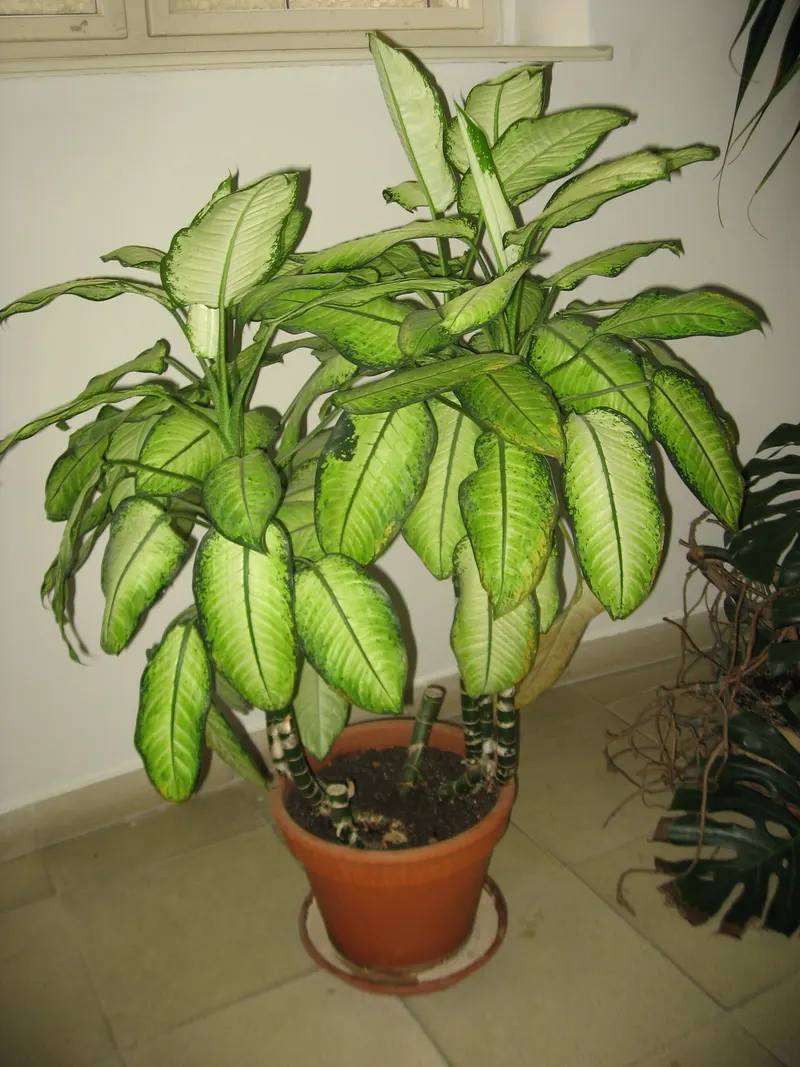
What it does for you
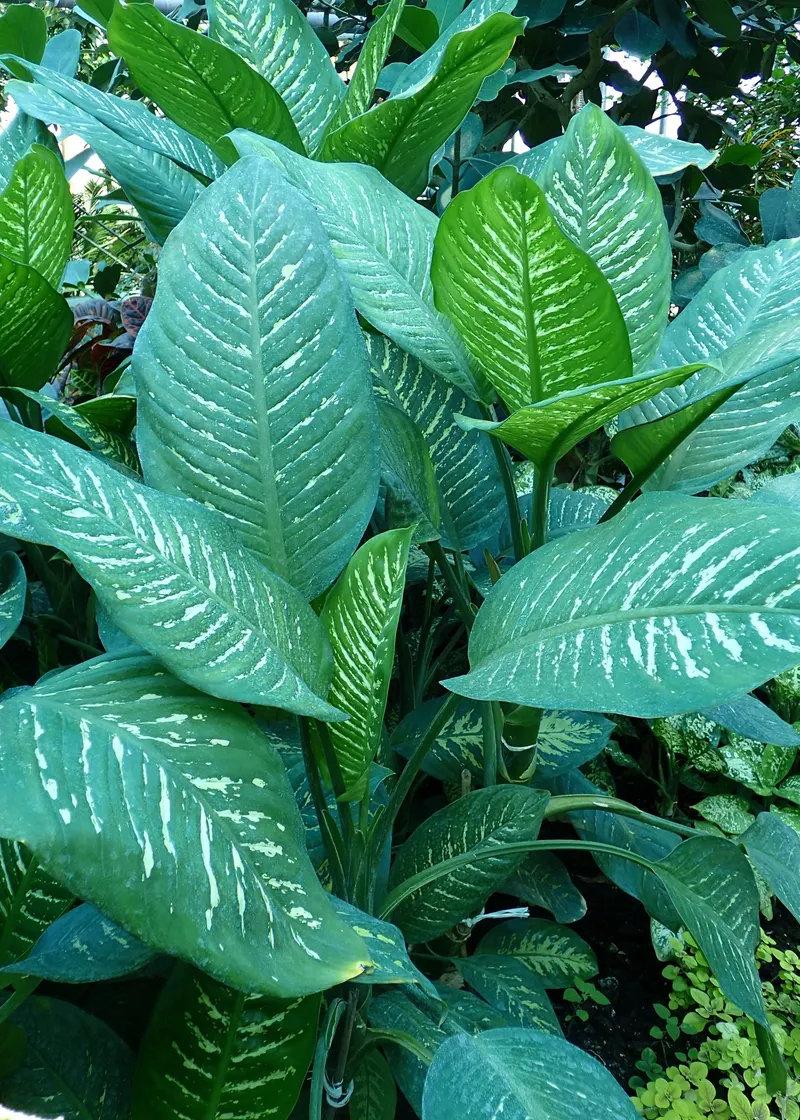
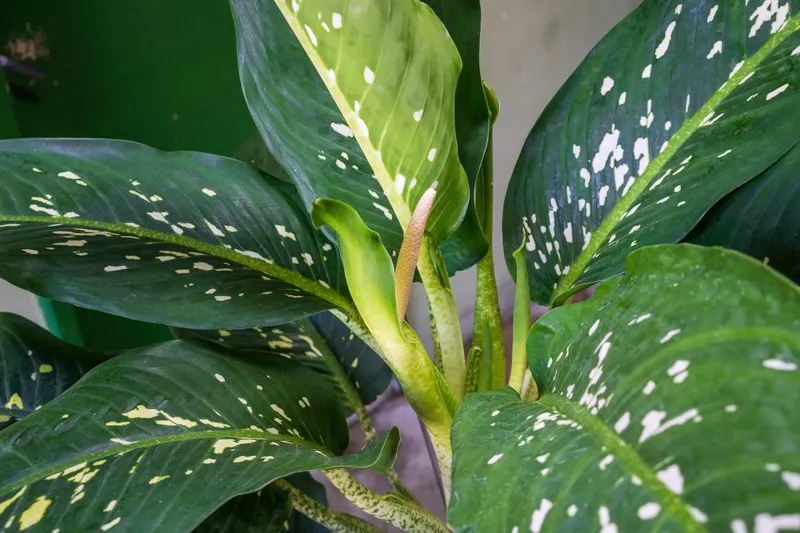
The dieffenbachia brings tropical flair into your room: large, glossy leaves patterned in cream, white or yellow depending on the variety1. It's considered an easy houseplant that puts up with a lot2, and it copes with darker corners too – though it grows more slowly there3. It doesn't measurably clean the air: for that you'd need ten to a thousand plants per square metre4.
Origin & history
In the wild, the dieffenbachia grows in the Caribbean and tropical South America, from Cuba to Bolivia and Brazil7,8, on the shady forest floor9. In shops it's often sold as D. maculata, D. picta or D. amoena – botanically they all belong to Dieffenbachia seguine1.
It's named after Dieffenbach, who ran the palace gardens in Vienna in the 1830s1. The name "dumb cane" comes from the fact that its sap can literally leave you speechless2. It was even misused to punish enslaved people9.
Caution
All parts are full of needle-shaped calcium oxalate crystals2. Ratings of how severe a poisoning is differ – the BfR expects a moderate course, NC State rates it high5,1 – so treat it as highly toxic. Biting into it causes burning and swelling of the lips, tongue and throat, making speaking and swallowing hard; sap in the eye can damage the cornea1. If the throat swells, get medical help immediately2. Cats and dogs drool, vomit and have trouble swallowing10. It's not a plant for homes with small children or pets2; wear gloves when cutting8. In an emergency: remove any remains from the mouth, give water or tea to drink, no milk, don't induce vomiting, call a poison control centre6.
Care
Light. Bright without direct sun, which yellows or bleaches the leaves3,1. In winter a little sun is fine2. In low light it gets leggy, loses variegation and its lower leaves8,3.
Water. Water thoroughly, then not again until the top 2–3 centimetres are dry2 – as a rule of thumb about once a week in summer. In winter just keep it slightly moist11. Constantly wet soil makes the lower leaves turn yellow and the stem rot3.
Temperature & humidity. 18–24 °C is ideal3, not below 15 °C – a safe margin, since below about 10–13 °C it gets damaged3,8. It responds to draughts by dropping leaves3. In dry air, neighbouring plants or a tray of damp gravel help3.
Soil, pot & repotting. Loose, free-draining houseplant soil, ideally with perlite3. Repot in early spring2 – as a rule of thumb every two to three years12.
Feeding. From early spring to early autumn every two to four weeks at half strength2.
Extras
Over the years the lower leaves drop and a stem becomes visible2. Flowers are rare indoors and inconspicuous3. Popular varieties: 'Camille' with cream-yellow leaves and a green edge, 'Tropic Snow' gets by with less light2.


Symptoms & help
| too little | too much | |||
|---|---|---|---|---|
| Water | Leaf edges and tips turn brown and dry. → Water thoroughly, then do the finger test more often. | Lower leaves turn yellow and drop, the stem goes soft at the base and rots. → Water less often, empty the cachepot. If the stem is rotten, save healthy shoot tips as cuttings. | ||
| Light | Long, bare stems, lower leaves drop, the pattern fades. → Move it somewhere brighter, but out of the midday sun. Cut back bare stems. | Leaves turn pale, yellow or discoloured. → Take it out of direct sun, give it a bright, shaded spot. | ||
| Fertiliser | Leaves turn yellowish and smaller, the plant hardly grows. → From early spring to early autumn feed at half strength every 2–4 weeks. | Brown, scorched leaf edges and tips. → Flush the soil thoroughly, don't feed for a while. | ||
| Warmth | Lower leaves suddenly drop – often after a draught or a sudden drop in temperature. → Move it somewhere warmer and sheltered, not below 15 °C, away from cold windows. |
Take it with you
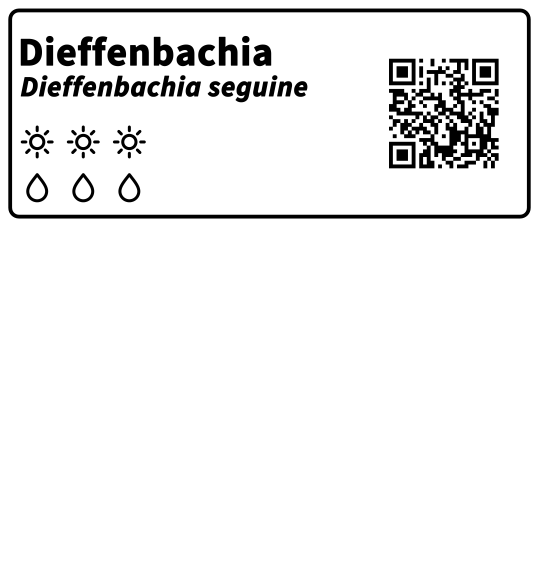
- Plant cardFront and back in A6 landscape – print it and keep it next to the pot
- PDF ↓
Notes on the files: Print & engrave
Licence and attribution for the plant labels: Readme (TXT)
Sources
- North Carolina State University Extension: Dieffenbachia seguine. North Carolina Extension Gardener Plant Toolbox. https://plants.ces.ncsu.edu/plants/dieffenbachia-seguine/ (accessed 12 October 2026)
- Russ, K., Pertuit, A. & Smith, B. H. (2015): Dieffenbachia. Clemson Cooperative Extension, Home & Garden Information Center, HGIC 1503. https://hgic.clemson.edu/factsheet/dieffenbachia/ (accessed 12 October 2026)
- UConn Home and Garden Education Center: Dieffenbachia. University of Connecticut, Fact Sheets. https://homegarden.cahnr.uconn.edu/factsheets/dieffenbachia (accessed 12 October 2026)
- Cummings, B. E. & Waring, M. S. (2020): Potted plants do not improve indoor air quality: a review and analysis of reported VOC removal efficiencies. Journal of Exposure Science & Environmental Epidemiology 30, 253–261. doi:10.1038/s41370-019-0175-9
- Bundesinstitut für Risikobewertung (BfR) (2017): Risiko Pflanze – Einschätzung und Hinweise. BfR-Broschüre. https://www.bfr.bund.de/cm/350/risiko-pflanze-einschaetzung-und-hinweise.pdf (accessed 12 October 2026)
- Bundesinstitut für Risikobewertung (BfR): Giftpflanzen: Wie kann man sich schützen und was ist bei einer Vergiftung zu tun? Fragen und Antworten. https://www.bfr.bund.de/fragen-und-antworten/thema/giftpflanzen-wie-kann-man-sich-schuetzen-und-was-ist-bei-einer-vergiftung-zu-tun/ (accessed 11 October 2026)
- Royal Botanic Gardens, Kew: Dieffenbachia seguine (Jacq.) Schott. Plants of the World Online. https://powo.science.kew.org/taxon/urn:lsid:ipni.org:names:86911-1 (accessed 12 October 2026)
- Chen, J., McConnell, D. B., Henny, R. J. & Everitt, K. C. (2003): Cultural Guidelines for Commercial Production of Interiorscape Dieffenbachia. UF/IFAS Extension, ENH880 (reviewed 2018). https://ask.ifas.ufl.edu/publication/EP137 (accessed 12 October 2026)
- Lachelin, L.: Dieffenbachia seguine. Oxford University Plants 400, Department of Biology, University of Oxford. https://herbaria.plants.ox.ac.uk/bol/plants400/profiles/CD/Dieffenbachia (accessed 12 October 2026)
- ASPCA Animal Poison Control Center: Dieffenbachia. Toxic and Non-Toxic Plant List. https://www.aspca.org/pet-care/animal-poison-control/toxic-and-non-toxic-plants/dieffenbachia (accessed 12 October 2026)
- Royal Horticultural Society: Dieffenbachia 'Camille' (v). RHS Find a Plant. https://www.rhs.org.uk/plants/96172/dieffenbachia-camille-v/details (accessed 12 October 2026)
- Royal Horticultural Society: How to grow houseplants. RHS Growing Guide. https://www.rhs.org.uk/plants/types/houseplants/growing-guide (accessed 11 October 2026)
- Berger, J., Essah, E. & Blanuša, T. (2024): The impact of plants on the humidity of naturally-ventilated office indoor environments. Journal of Building Engineering 86, 108814. doi:10.1016/j.jobe.2024.108814
- DelPrince, J. M. & Perry, J. H. (2021): Care & Selection of Indoor Plants. Mississippi State University Extension, Publication 1012. https://extension.msstate.edu/publications/care-selection-indoor-plants (accessed 11 October 2026)
- Royal Horticultural Society: Palms: indoors. RHS Advice. https://www.rhs.org.uk/plants/types/trees/indoor-palms (accessed 12 October 2026)