What it does for you
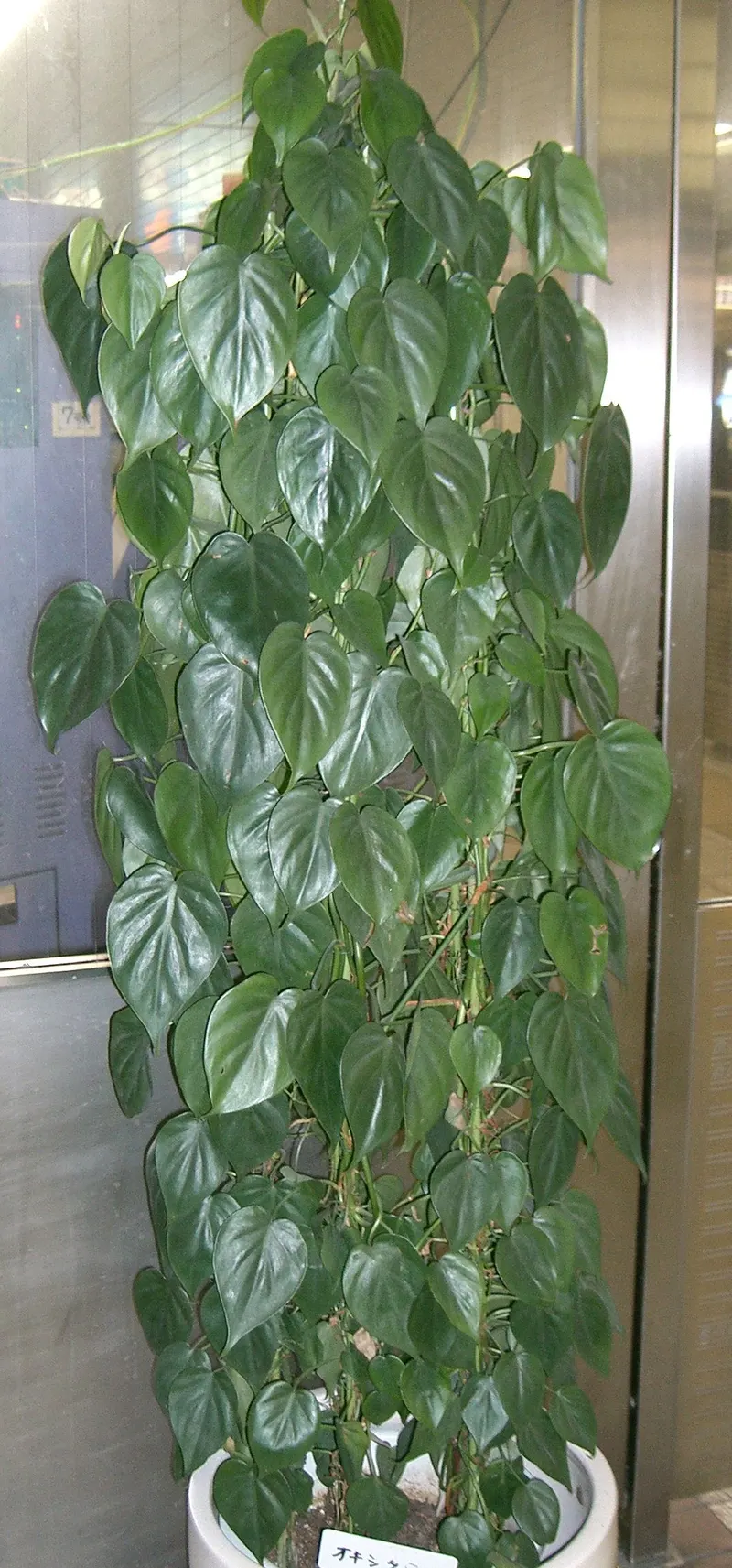
The heartleaf philodendron is perhaps the most popular philodendron sold today1. It can survive for long periods in extremely low light2. Its stems trail from a high shelf or climb a moss pole3. It was part of the 1989 NASA study, tested for formaldehyde in a sealed chamber4. But in real homes, for a noticeable effect you'd need, depending on the study, ten to a thousand plants per square metre5.
Origin & history
It grows wild from Mexico through Central America and the Caribbean to Peru, Bolivia and Brazil, as an epiphyte, mainly in the wet tropics7.
The genus name comes from Greek for "to love" and "tree", as many species climb trees; hederaceum means ivy-like1. Older names are Philodendron scandens and P. oxycardium2; POWO now files both under varieties of P. hederaceum8,9. It may also be labelled Philodendron cordatum, an older, inaccurate name10.
Caution
It contains insoluble calcium oxalates; in cats and dogs it causes pain and swelling of the mouth, tongue and lips, heavy drooling, vomiting and difficulty swallowing11. NC State rates the poison severity for people as low, but lists contact dermatitis2. The RHS calls philodendrons poisonous, says the sap can irritate the skin and advises gloves3; the University of Zurich's veterinary toxicology database lists the whole plant as poisonous12. We use the more cautious rating.
Care
The RHS, Iowa State and the UF/IFAS production guide give their advice for philodendrons in general.
Light. Bright but indirect light; direct summer sun can scorch the leaves. With too little light it gets leggy and makes fewer, smaller leaves3.
Water. Wait until the top of the compost has dried, and never leave it standing in water – saturated compost can eventually rot the roots3. Water less from autumn to late winter1. Trailing philodendrons are very unforgiving of overwatering10. As a rule of thumb, that means about once a week in summer.
Temperature & humidity. At least 15 °C, away from hot radiators and cold draughts; it's happy with the lower humidity of most homes3. 18–27 °C is well tolerated13. UF/IFAS lists lower leaves turning yellow after several hours at 1–4 °C among the problems of philodendrons in production and indoors14.
Soil, pot & repotting. A loose, free-draining, slightly acidic mix, such as two parts orchid compost to one part peat-free ericaceous compost. It can usually stay in its pot for at least a couple of years, or until the roots are densely packed. Repot in spring, into a pot only a few centimetres larger than the root ball3. Iowa State: repot when it is overcrowded13.
Feeding. From spring to early autumn with a general houseplant fertiliser3; lightly, once or twice a month13. Too little nitrogen makes the leaves yellowish and small14.
Extras
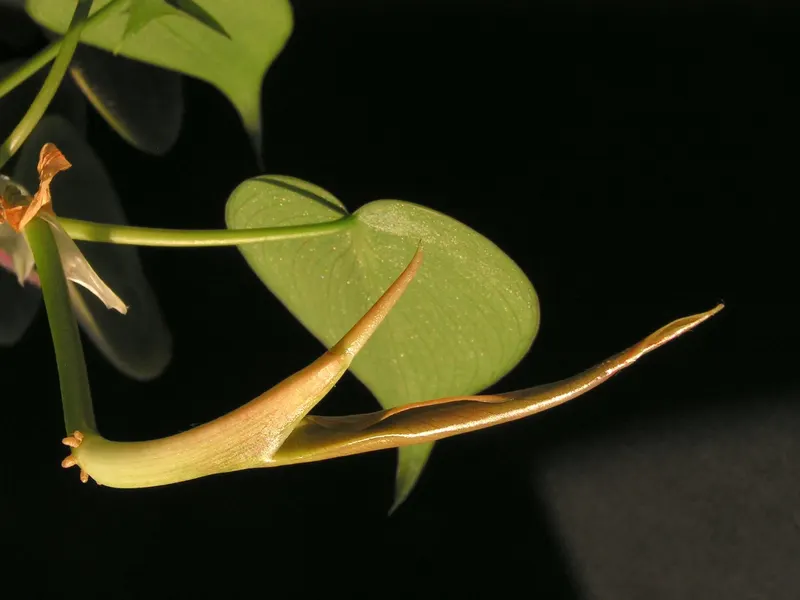
Climbing a support outdoors, its leaves grow up to 30 cm long or more15. In cultivation it rarely flowers2. Cultivars include 'Brasil' with a yellow to light green central stripe and the yellow to chartreuse 'Lemon Lime'2.

Symptoms & help
| too little | too much | |||
|---|---|---|---|---|
| Water | Yellowing leaves, leaves drop, the vines wither; roots rot. → Let the surface dry out between waterings. Never leave it standing in water, and don't water more. | |||
| Light | Leggy stems with fewer, smaller leaves. → Move it somewhere brighter, but out of direct sun. | Discoloured or scorched leaves. → Move it out of direct sun. | ||
| Fertiliser | Yellowish leaves that stay small. → Feed about once a month from spring to early autumn. | |||
| Warmth | The lower leaves turn yellow after several hours just above freezing. → Keep it above 15 °C and away from cold draughts. |
Take it with you
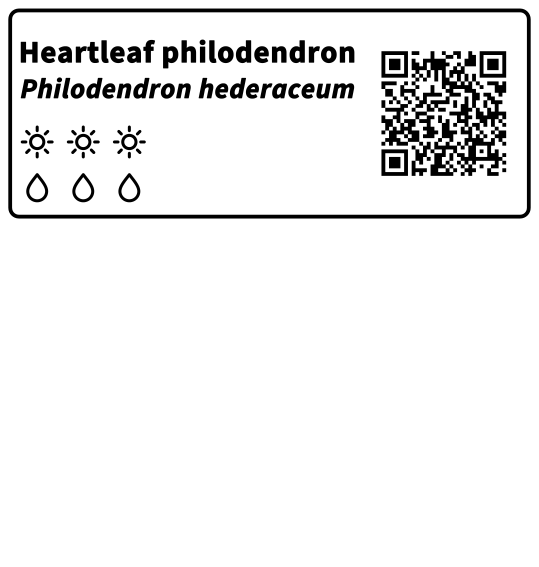
- Plant cardFront and back in A6 landscape – print it and keep it next to the pot
- PDF ↓

Notes on the files: Print & engrave
Licence and attribution for the plant labels: Readme (TXT)
Sources
- Missouri Botanical Garden: Philodendron hederaceum. Plant Finder. https://www.missouribotanicalgarden.org/PlantFinder/PlantFinderDetails.aspx?kempercode=b611 (accessed 20 October 2026)
- North Carolina State University Extension: Philodendron hederaceum. North Carolina Extension Gardener Plant Toolbox. https://plants.ces.ncsu.edu/plants/philodendron-hederaceum/ (accessed 20 October 2026)
- Royal Horticultural Society: Philodendron. RHS Growing Guide. https://www.rhs.org.uk/plants/philodendron/growing-guide (accessed 20 October 2026)
- Wolverton, B. C., Johnson, A. & Bounds, K. (1989): Interior Landscape Plants for Indoor Air Pollution Abatement. NASA Technical Memorandum TM-101766. https://ntrs.nasa.gov/citations/19930073077
- Cummings, B. E. & Waring, M. S. (2020): Potted plants do not improve indoor air quality: a review and analysis of reported VOC removal efficiencies. Journal of Exposure Science & Environmental Epidemiology 30, 253–261. doi:10.1038/s41370-019-0175-9
- ASPCA Animal Poison Control Center: Golden Pothos (Epipremnum aureum). Toxic and Non-Toxic Plant List. https://www.aspca.org/pet-care/animal-poison-control/toxic-and-non-toxic-plants/golden-pothos (accessed 11 October 2026)
- Royal Botanic Gardens, Kew: Philodendron hederaceum (Jacq.) Schott. Plants of the World Online. https://powo.science.kew.org/taxon/urn:lsid:ipni.org:names:87797-1 (accessed 20 October 2026)
- Royal Botanic Gardens, Kew: Philodendron scandens K.Koch & Sello. Plants of the World Online. https://powo.science.kew.org/taxon/urn:lsid:ipni.org:names:87997-1 (accessed 20 October 2026)
- Royal Botanic Gardens, Kew: Philodendron hederaceum var. oxycardium (Schott) Croat. Plants of the World Online. https://powo.science.kew.org/taxon/urn:lsid:ipni.org:names:20007818-1 (accessed 20 October 2026)
- Lisy, M. (2026): I "Heart" Philodendrons. UConn Home & Garden Education Center. https://homegarden.cahnr.uconn.edu/?p=19107 (accessed 20 October 2026)
- ASPCA Animal Poison Control Center: Heartleaf Philodendron (Philodendron hederaceum). Toxic and Non-Toxic Plant List. https://www.aspca.org/pet-care/aspca-poison-control/toxic-and-non-toxic-plants/heartleaf-philodendron (accessed 20 October 2026)
- Institut für Veterinärpharmakologie und -toxikologie, Universität Zürich: Philodendron scandens. Arznei- und Giftpflanzen (CliniTox). https://www.vetpharm.uzh.ch/giftdb/pflanzen/0124_bot.htm (accessed 20 October 2026)
- Steil, A.: How do I care for a philodendron? Iowa State University Extension and Outreach, Yard and Garden FAQ. https://yardandgarden.extension.iastate.edu/faq/how-do-i-care-philodendron (accessed 20 October 2026)
- McConnell, D. B., Chen, J., Henny, R. J. & Everitt, K. C. (2003): Cultural Guidelines for Commercial Production of Interiorscape Philodendron. UF/IFAS Extension, EDIS ENH893. https://edis.ifas.ufl.edu/publication/EP150 (accessed 20 October 2026)
- Gilman, E. F., Klein, R. W. & Hansen, G. (2023): Philodendron scandens: Heart Leaf Philodendron. UF/IFAS Extension, EDIS FPS472. https://edis.ifas.ufl.edu/publication/FP472 (accessed 20 October 2026)
- Berger, J., Essah, E. & Blanuša, T. (2024): The impact of plants on the humidity of naturally-ventilated office indoor environments. Journal of Building Engineering 86, 108814. doi:10.1016/j.jobe.2024.108814
- Royal Horticultural Society: How to take cuttings from houseplants. RHS Growing Guide. https://www.rhs.org.uk/plants/types/houseplants/how-to-take-cuttings-from-houseplants (accessed 14 October 2026)
- DelPrince, J. M. & Perry, J. H. (2021): Care & Selection of Indoor Plants. Mississippi State University Extension, Publication 1012. https://extension.msstate.edu/publications/care-selection-indoor-plants (accessed 11 October 2026)
- Royal Horticultural Society: Palms: indoors. RHS Advice. https://www.rhs.org.uk/plants/types/trees/indoor-palms (accessed 12 October 2026)