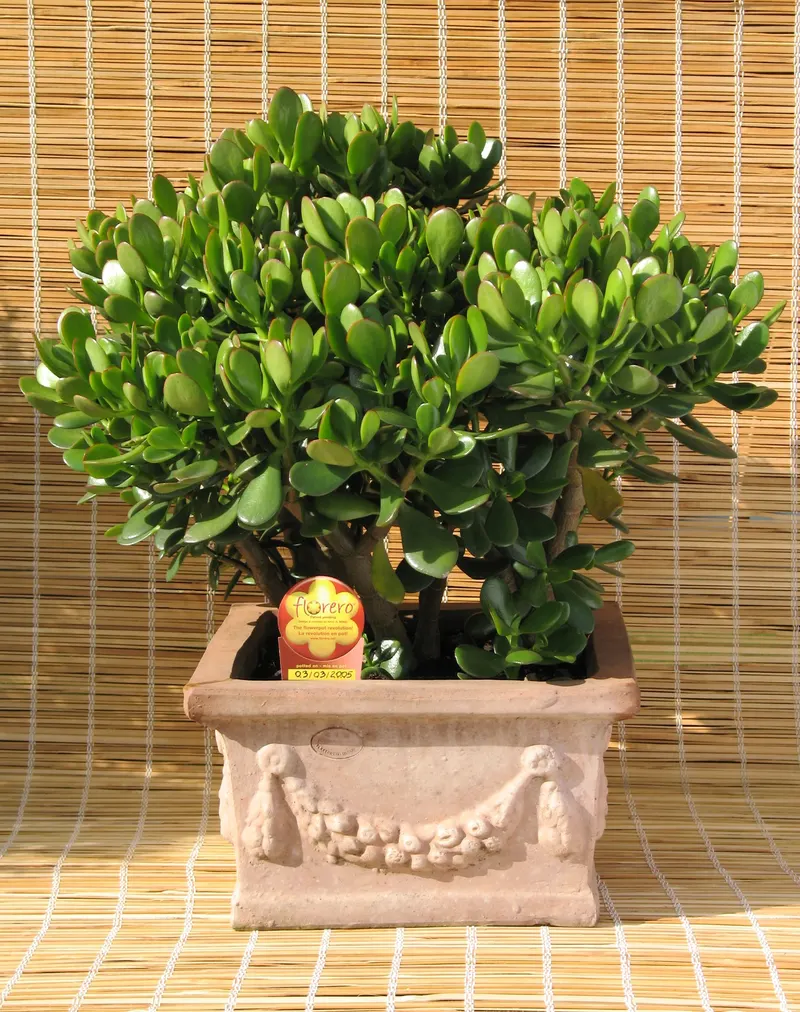
What it does for you
Over the years the jade plant grows into a small tree with a thick, woody trunk1,2. As a succulent it stores water in its leaves, stem and roots and forgives neglect – it even likes warm, dry heated air2. In a sunny spot the leaves get red edges2.
Origin & history
In the wild it grows in south-eastern South Africa as far as south-eastern Mozambique5,3, mainly in the bushland of the Eastern Cape and KwaZulu-Natal on dry, rocky slopes2. Crassula means "thick", ovata "egg-shaped" – after the fleshy, oval leaves2.
Older names are Crassula argentea and C. portulacea6. It has since gone wild in the Canary Islands, Madeira and California5.
Caution
For people the jade plant is considered non-toxic to mildly toxic. Recent literature describes no poisonings, only isolated cases of stomach ache and vomiting7. After nibbling on it, cats and dogs may vomit and become lethargic and unsteady on their feet; which substance causes this is unknown8.
Care
Light. Best with four or more hours of direct sun2, e.g. at a south- or west-facing window (southern hemisphere: north or west)6. Get it used to harsh sun gradually3. Bright without sun works too, but then the leaves stay green2.
Water. From mid-spring to mid-autumn water thoroughly when the top 2–3 cm are dry, and let the water drain away3. From late autumn until early spring it goes into its winter rest: cool and almost dry4. In the weeks in between, water less and less in autumn and gradually more again in spring.
Temperature & humidity. Around 16–21 °C by day, it can be cooler at night3, in winter 8–10 °C at night4. Hard frost kills it2. It doesn't care about humidity2.
Soil, pot & repotting. Cactus or succulent soil, or potting compost with perlite or sand2. Heavy clay or ceramic pots work well3, but not too big, or the soil stays wet for too long4. Repot every two to three years in spring3,4.
Feeding. From spring to early autumn feed every two months3,2.
Extras
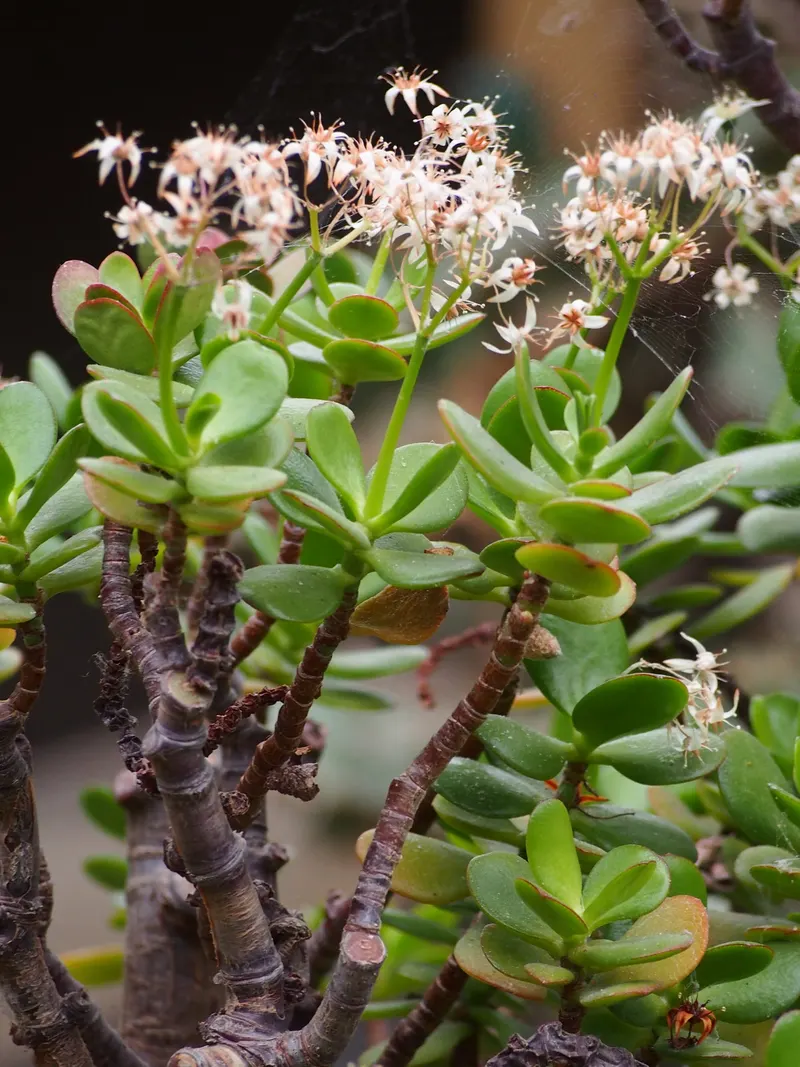
Older plants carry white to pink star-shaped flowers3. As a short-day plant it needs long nights for this: in autumn water less, keep it around 13 °C at night and don't switch on a lamp in the evening2.
Its family, the stonecrops (Crassulaceae), gave CAM photosynthesis its name – it was first described in them9. The most common pest is mealybugs2.

Symptoms & help
| too little | too much | |||
|---|---|---|---|---|
| Water | The leaves shrivel, growth is slow. → In summer water thoroughly as soon as the soil has dried out on top. | Leaves drop, the stem goes soft and rots, leaves get corky blisters. → Let the soil dry out, don't leave water standing in the cachepot. In winter keep it almost dry. | ||
| Light | Deep green leaves, long, drooping shoots, hardly any red leaf edges. → Move it to the brightest window with direct sun. | Brown, scorched patches; damaged leaves die and drop. → After winter or a move, get it used to harsh sun gradually. | ||
| Warmth | Frozen leaves die and drop. → Keep it frost-free and not below 5 °C. |
Take it with you
- Plant cardFront and back in A6 landscape – print it and keep it next to the pot
- PDF ↓

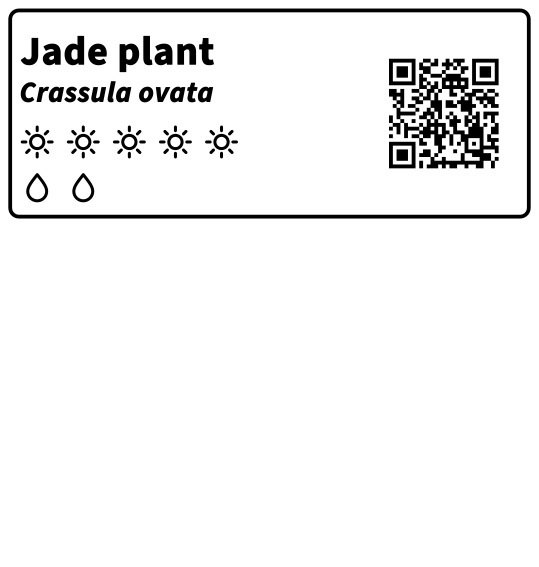
Notes on the files: Print & engrave
Licence and attribution for the plant labels: Readme (TXT)
Sources
- NC State Extension: Crassula ovata. North Carolina Extension Gardener Plant Toolbox. https://plants.ces.ncsu.edu/plants/crassula-ovata/ (accessed 14 October 2026)
- Mahr, S. (2025): Jade Plant, Crassula ovata. University of Wisconsin–Madison, Division of Extension, Wisconsin Horticulture. https://hort.extension.wisc.edu/articles/jade-plant-crassula-ovata/ (accessed 14 October 2026)
- UConn Home & Garden Education Center: Jade Plants. University of Connecticut, Fact Sheets. https://homegarden.cahnr.uconn.edu/factsheets/jade-plants (accessed 14 October 2026)
- Royal Horticultural Society: How to grow houseplant cacti and succulents. RHS Growing Guide. https://www.rhs.org.uk/plants/types/cacti-succulents/houseplants/growing-guide (accessed 14 October 2026)
- Royal Botanic Gardens, Kew: Crassula ovata (Mill.) Druce. Plants of the World Online. https://powo.science.kew.org/taxon/urn:lsid:ipni.org:names:273350-1 (accessed 14 October 2026)
- Royal Horticultural Society: Crassula ovata (jade plant). RHS Plants. https://www.rhs.org.uk/plants/4739/crassula-ovata/details (accessed 14 October 2026)
- Informationszentrale gegen Vergiftungen NRW (Giftzentrale Bonn): Dickblatt-Arten (Crassula arborescens, C. portulacea). Pflanzen. https://gizbonn.de/giftzentrale-bonn/pflanzen/dickblatt-arten (accessed 14 October 2026)
- ASPCA Animal Poison Control Center: Jade Plant (Crassula argentea). Toxic and Non-Toxic Plant List. https://www.aspca.org/pet-care/aspca-poison-control/toxic-and-non-toxic-plants/jade-plant (accessed 14 October 2026)
- Lüttge, U. (2004): Ecophysiology of Crassulacean Acid Metabolism (CAM). Annals of Botany 93, 629–652. doi:10.1093/aob/mch087
- Royal Horticultural Society: How to take cuttings from houseplants. RHS Growing Guide. https://www.rhs.org.uk/plants/types/houseplants/how-to-take-cuttings-from-houseplants (accessed 14 October 2026)
- DelPrince, J. M. & Perry, J. H. (2021): Care & Selection of Indoor Plants. Mississippi State University Extension, Publication 1012. https://extension.msstate.edu/publications/care-selection-indoor-plants (accessed 11 October 2026)
- Royal Horticultural Society: Palms: indoors. RHS Advice. https://www.rhs.org.uk/plants/types/trees/indoor-palms (accessed 12 October 2026)