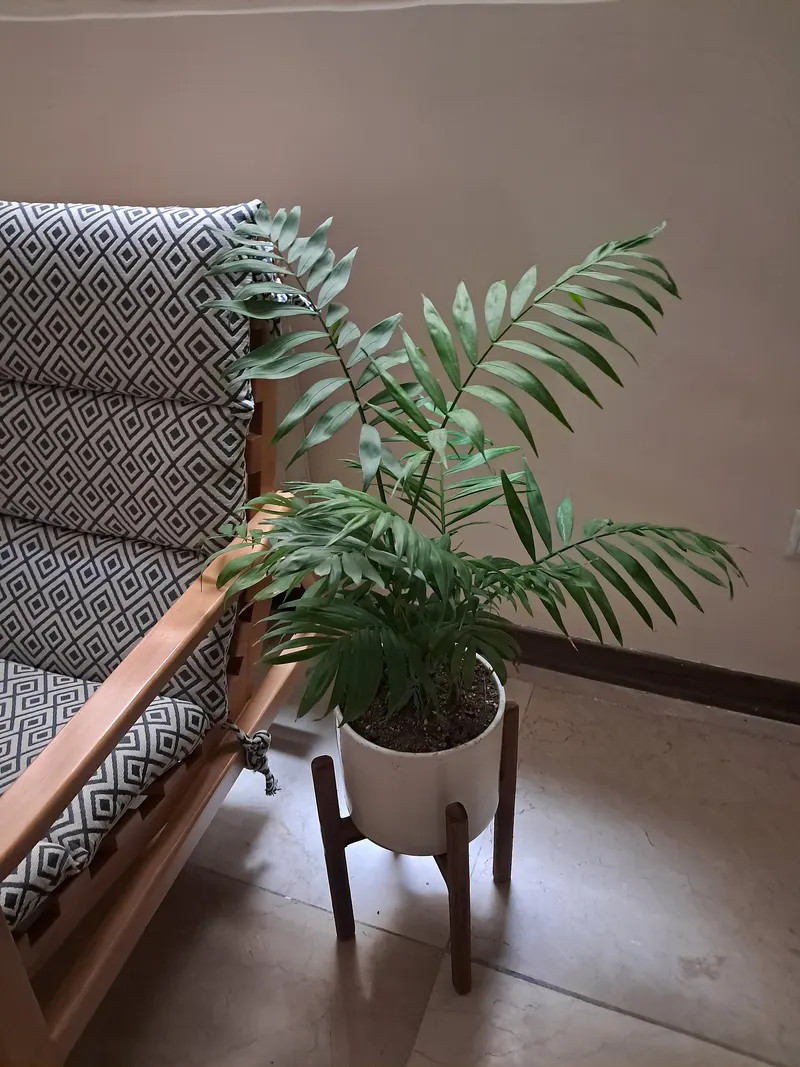
What it does for you
The parlour palm is one of several palms that are easy indoors and tolerate fairly low light1. It grows slowly and stays compact – usually 30–60 centimetres2. The ASPCA lists it as non-toxic for cats and dogs3.
Origin & history
It grows wild from Mexico to Honduras7, in the shade of larger trees in the rainforest2. A study in south-eastern Mexico harvested leaves from wild populations: they stayed roughly stable, but heavier harvesting meant fewer fruits8.
In Victorian times it took pride of place in the parlour – hence its name2. NC State also lists it as neanthe bella palm4; Neanthe bella is a synonym of its botanical name7.
Caution
The ASPCA lists the parlour palm as non-toxic for cats and dogs3. For people the sources differ: UNL lists it as non-toxic9, NC State as low in toxicity – the only problem it names is skin irritation from the fruit juice4. We use the more cautious rating. The fruit pulp of a number of palms contains calcium oxalate crystals; for most Chamaedorea, wear gloves when handling the fruits10.
Care
Light. Bright, indirect light is best; in partial shade it grows more slowly. Direct sun scorches the fronds2. It even manages away from the window1.
Water. Water when the surface is dry, ideally with rainwater at room temperature; hard tap water can turn the fronds brown. Don't leave it standing in water for long, and water less in winter2 – as a rule of thumb about once a week in summer.
Temperature & humidity. Ideal is 20–27 °C from spring to autumn; it tolerates cooler winters2. The RHS growing guide names 10 °C as the lower limit2, its palm guide and Clemson give 16 °C as the winter minimum for this palm1,11 – to be safe, keep it above 16 °C. On humidity the sources differ: from no need for high humidity2 and low to medium4 to moderate to high (Clemson, for parlour palms)11 and "humid conditions are necessary"1 – medium is a fair middle. Dry air browns the tips; regular misting helps and deters spider mites2.
Soil, pot & repotting. Light, free-draining, peat-free ericaceous (acidic) compost with some grit2. Repot in spring once the roots are crowded, only a couple of centimetres bigger – too big a pot risks root rot2. Every other year is enough4; for palms in general, Clemson says every two to three years11. In the years between, replace the top 5 cm of compost with fresh1.
Feeding. A balanced liquid feed once a month from spring to autumn2. For palms in general, the RHS says fortnightly1, Clemson two to three times a year with slow-release palm fertiliser11. Too much fertiliser browns the leaf tips11.
Extras
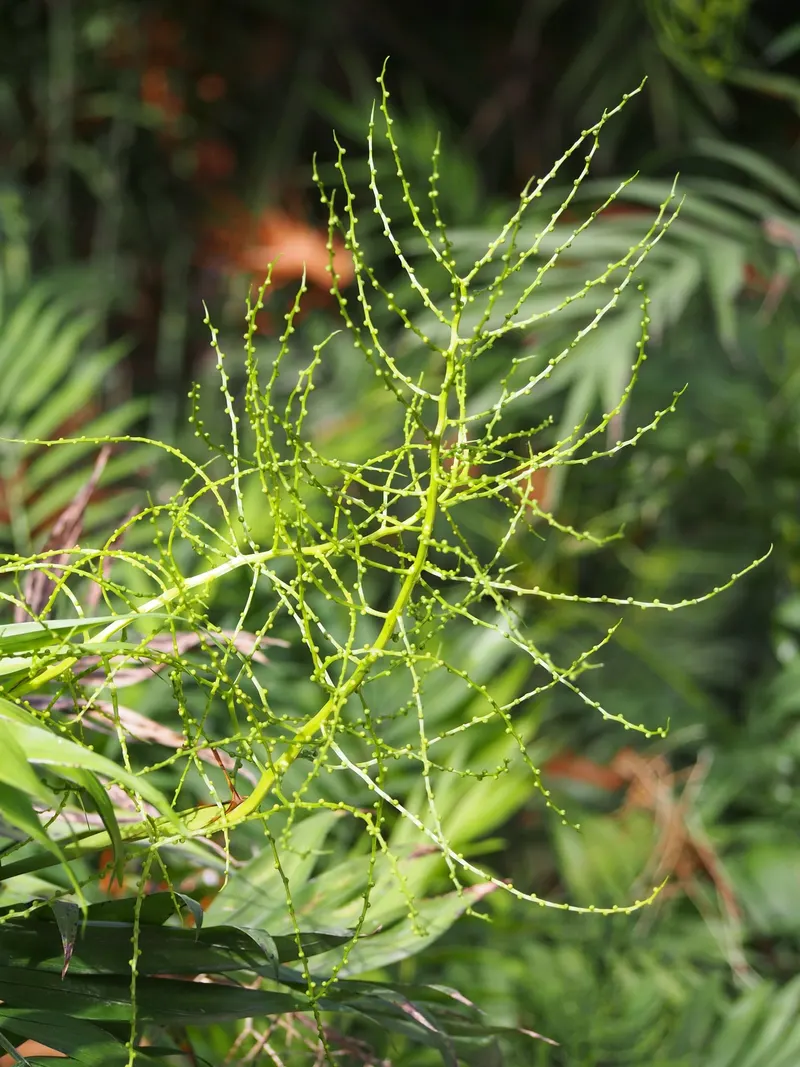
The parlour palm is dioecious: black fruits only form when female flowers are pollinated by a male plant2. Only mature plants flower12, bright light may encourage it2, fruits rarely form indoors4.

Symptoms & help
| too little | too much | |||
|---|---|---|---|---|
| Water | Brown, dry leaf tips. → Water thoroughly as soon as the surface is dry. Mist regularly in heated rooms. | Fronds turn brown; in wet soil the roots rot. → Let the surface dry before watering, tip away water from the saucer after a short while. | ||
| Light | Fronds turn yellow, the plant hardly grows. → Move it somewhere brighter, but out of direct sun. | Scorched, brown patches on the fronds. → Move it out of direct sun. | ||
| Fertiliser | Poor growth although light and water are right. → From spring to autumn feed once a month with liquid fertiliser. | The tips of the lower fronds turn brown and die. → Feed less often – monthly in the growing season is plenty. | ||
| Warmth | Reddish-brown, dead patches on the fronds a few days after a cold spell or draught. → Move it somewhere warmer, away from cold draughts at windows and doors. |
Take it with you
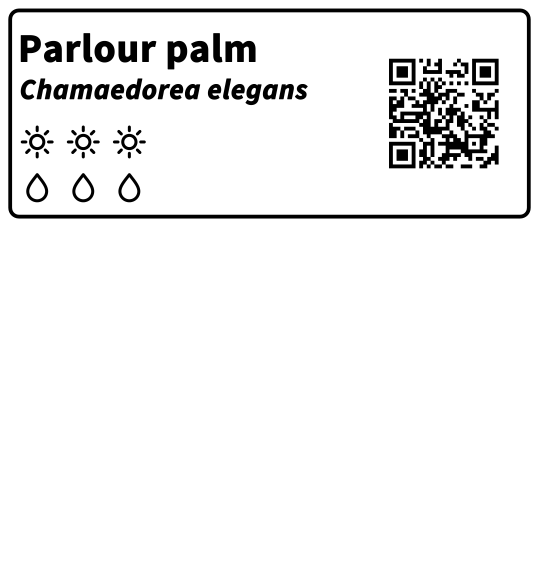
- Plant cardFront and back in A6 landscape – print it and keep it next to the pot
- PDF ↓
Notes on the files: Print & engrave
Licence and attribution for the plant labels: Readme (TXT)
Sources
- Royal Horticultural Society: Palms: indoors. RHS Advice. https://www.rhs.org.uk/plants/types/trees/indoor-palms (accessed 12 October 2026)
- Royal Horticultural Society: How to grow chamaedorea. RHS Growing Guide. https://www.rhs.org.uk/plants/chamaedorea/growing-guide (accessed 17 October 2026)
- ASPCA Animal Poison Control Center: Parlor Palm (Chamaedorea elegans). Toxic and Non-Toxic Plant List. https://www.aspca.org/pet-care/animal-poison-control/toxic-and-non-toxic-plants/parlor-palm (accessed 17 October 2026)
- North Carolina State University Extension: Chamaedorea elegans. Extension Gardener Plant Toolbox. https://plants.ces.ncsu.edu/plants/chamaedorea-elegans/ (accessed 17 October 2026)
- Wolverton, B. C., Johnson, A. & Bounds, K. (1989): Interior Landscape Plants for Indoor Air Pollution Abatement. NASA Technical Memorandum TM-101766. https://ntrs.nasa.gov/citations/19930073077
- Cummings, B. E. & Waring, M. S. (2020): Potted plants do not improve indoor air quality: a review and analysis of reported VOC removal efficiencies. Journal of Exposure Science & Environmental Epidemiology 30, 253–261. doi:10.1038/s41370-019-0175-9
- Royal Botanic Gardens, Kew: Chamaedorea elegans Mart. Plants of the World Online. https://powo.science.kew.org/taxon/urn:lsid:ipni.org:names:54865-2 (accessed 17 October 2026)
- Valverde, T., Hernández-Apolinar, M. & Mendoza-Amaro, S. (2006): Effect of Leaf Harvesting on the Demography of the Tropical Palm Chamaedorea elegans in South-Eastern Mexico. Journal of Sustainable Forestry 23(1), 85–105. doi:10.1300/J091v23n01_05
- University of Nebraska–Lincoln Extension in Lancaster County (2015): Toxicity of Common Houseplants. Horticulture fact sheet 031 (archived copy). https://web.archive.org/web/20241123081117/https://lancaster.unl.edu/hort/factsheets/031_toxicityhouseplants.pdf (accessed 12 October 2026)
- Meerow, A. W. & Broschat, T. K.: Palm Seed Germination. UF/IFAS Extension, Publication BUL274/EP238. https://ask.ifas.ufl.edu/publication/EP238 (accessed 17 October 2026)
- Russ, K. & Pertuit, A. (revised by Smith, B. H.) (2015): Indoor Palms. Clemson Cooperative Extension, Home & Garden Information Center. https://hgic.clemson.edu/factsheet/indoor-palms/ (accessed 12 October 2026)
- Royal Horticultural Society: Chamaedorea elegans. RHS Plants. https://www.rhs.org.uk/plants/29185/chamaedorea-elegans/details (accessed 17 October 2026)
- Graves, K., Wilber, W., Wichman, T., Lewis, C., Hansen, G. & Klein, R. (originally Gilman, E. F.): Chamaedorea elegans, Parlor Palm, Neanthe Bella. UF/IFAS Extension, Publication FPS119/FP119. https://ask.ifas.ufl.edu/publication/FP119 (accessed 17 October 2026)
- Berger, J., Essah, E. & Blanuša, T. (2024): The impact of plants on the humidity of naturally-ventilated office indoor environments. Journal of Building Engineering 86, 108814. doi:10.1016/j.jobe.2024.108814
- DelPrince, J. M. & Perry, J. H. (2021): Care & Selection of Indoor Plants. Mississippi State University Extension, Publication 1012. https://extension.msstate.edu/publications/care-selection-indoor-plants (accessed 11 October 2026)