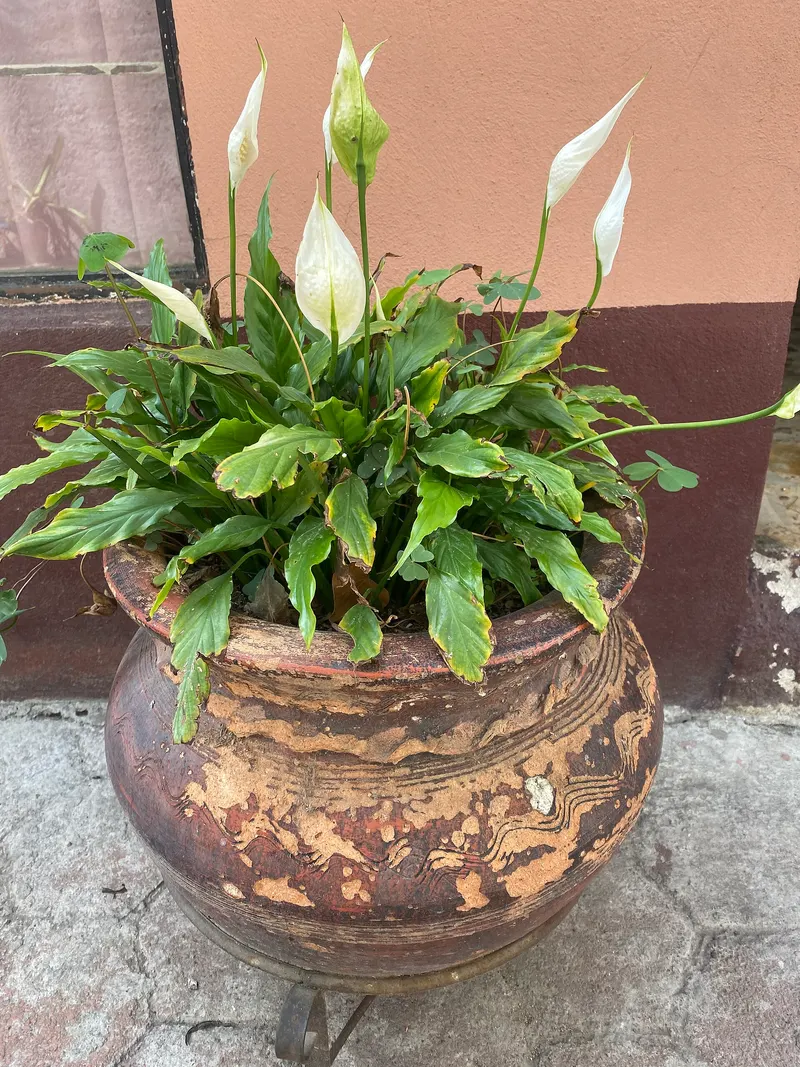
What it does for you
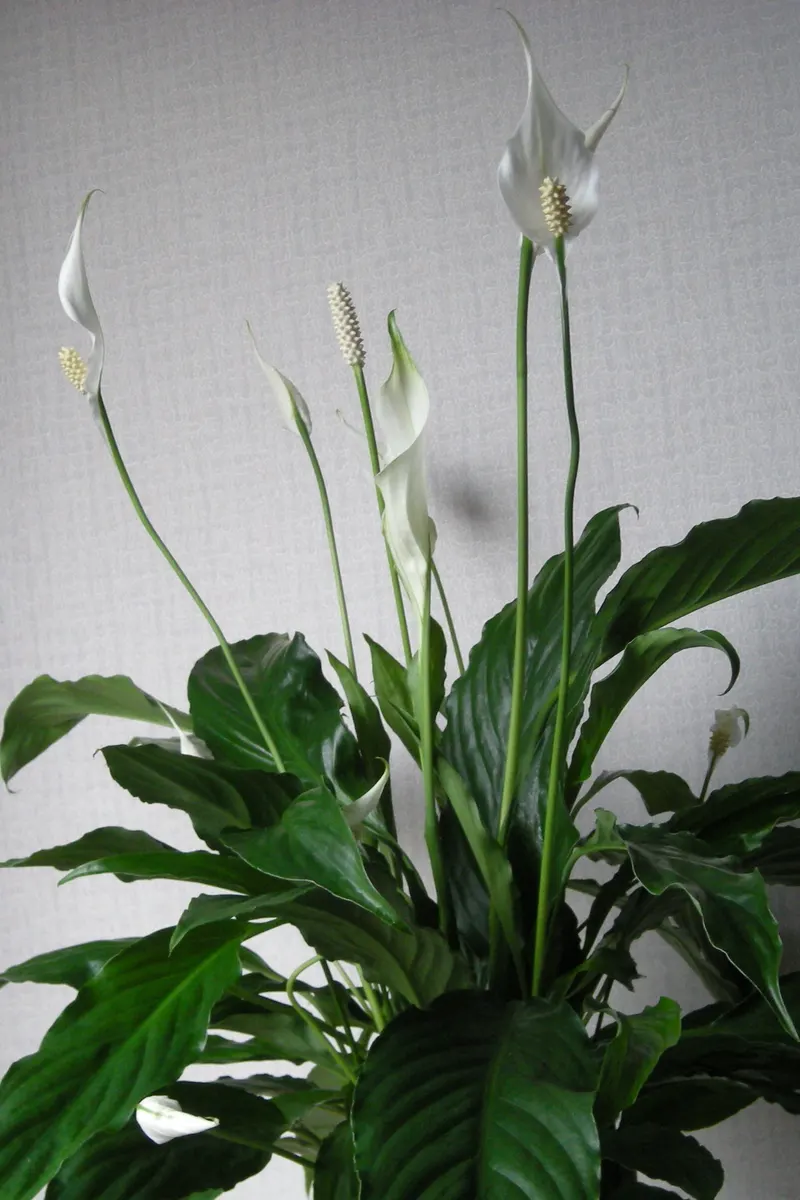
The peace lily is one of the few foliage plants that still flower in fairly low light1 – in deep shade, though, it rarely flowers2. The white "flower" is actually a bract wrapped around a spike of tiny flowers3. And it shows you when it's thirsty: it lets all its leaves droop – water it quickly and it recovers fast2.
Origin & history
There are many varieties on sale, from 30 centimetres to over a metre tall3. The one sold most often is Spathiphyllum wallisii2 – and that's the species this page is about. The sizes on the fact sheet are those of typical shop plants and larger cultivars; the pure species stays at about 30–40 cm1,6. In the wild it grows in Colombia and Venezuela7. The genus lives in the understorey of humid rainforests in Central and South America, a few species also in South-East Asia3.
The name "peace lily" comes from the bracts, which look like white flags2. It isn't a true lily, though, but a member of the arum family1.
Caution
The peace lily contains calcium oxalate crystals. Chewing on it causes severe pain and burning in the lips, tongue and throat6. Cats and dogs drool, vomit and have trouble swallowing8. So keep it out of reach of children and pets. NC State lists no contact dermatitis6, but the RHS warns that the sap can irritate the skin2 – wear gloves when cutting.
Care
Light. Ideally bright without direct sun, which burns the leaves. It tolerates low light1, but then grows slowly and hardly flowers2.
Water. Water as soon as the top centimetres of soil are dry, less in winter2 – as a rule of thumb about once a week in summer. Never leave it standing in water, or the roots rot1. If it droops, a thorough watering helps within hours. If that happens often, the leaf edges turn brown3.
Temperature & humidity. Normal room temperature suits it: the RHS names 12–24 °C2, Clemson up to about 29 °C by day; below about 15 °C it risks cold damage1. Don't put it next to a radiator or in a draught. If the air is too dry, the leaf edges turn brown – a tray of damp gravel helps2.
Soil, pot & repotting. Peat-free houseplant soil with some perlite2. Repot in spring once roots fill the pot; freshly bought plants only after one to two years2. The new pot should be only slightly bigger than the root ball, otherwise the soil stays wet for too long1.
Feeding. From spring to mid-autumn every few weeks2, as a rule of thumb about monthly at most and at weak strength; Clemson even advises only every 6–8 weeks at quarter strength1. Too much fertiliser burns leaf tips and roots3.
Extras
Left to itself, the peace lily flowers mainly in spring and summer. The bracts last a long time and turn green with age2. Young plants under a year old often don't flower yet1. Nurseries often make it flower with the plant hormone gibberellin – at any time of year3.

Symptoms & help
| too little | too much | |||
|---|---|---|---|---|
| Water | All leaves droop limply; if this happens often, tips and edges turn brown. → Water thoroughly – within a few hours it perks up again. After that, check more often. | Leaves wilt despite wet soil, edges turn yellow or brown, roots have black tips. → Water less often, empty the cachepot, remove rotten roots and replant in fresh, loose soil. | ||
| Light | Flowers little or not at all. → Move it somewhere brighter, but without direct sun. | Leaves turn pale and get brown, burnt patches. → Move it out of direct sun to a bright, shaded spot. | ||
| Fertiliser | Hardly grows, the leaves turn yellowish – often between veins that stay green. → From spring to mid-autumn, feed every 4–8 weeks at weak strength. | Brown leaf tips and edges. → Flush the soil thoroughly, don't feed for a few months. | ||
| Warmth | Grows slowly, dead patches spread inward from the leaf tips. → Move it somewhere warmer, away from cold windows and draughts – not below 15 °C. |
Take it with you
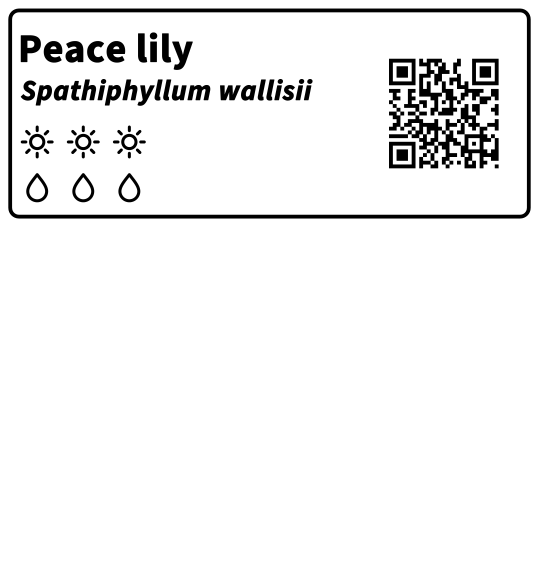
- Plant cardFront and back in A6 landscape – print it and keep it next to the pot
- PDF ↓

Notes on the files: Print & engrave
Licence and attribution for the plant labels: Readme (TXT)
Sources
- Kluepfel, M., Polomski, R. F. & Smith, B. H. (2022): Peace Lily. Clemson Cooperative Extension, Home & Garden Information Center, HGIC 1512. https://hgic.clemson.edu/factsheet/peace-lily/ (accessed 12 October 2026)
- Royal Horticultural Society: How to grow peace lilies. RHS Growing Guides. https://www.rhs.org.uk/plants/peace-lilies/how-to-grow-peace-lilies (accessed 12 October 2026)
- Chen, J., McConnell, D. B., Henny, R. J. & Everitt, K. C. (2003): Cultural Guidelines for Commercial Production of Interiorscape Spathiphyllum. UF/IFAS Extension, ENH958 (revised 2015). https://edis.ifas.ufl.edu/publication/EP161 (accessed 12 October 2026)
- Wolverton, B. C., Johnson, A. & Bounds, K. (1989): Interior Landscape Plants for Indoor Air Pollution Abatement. NASA Technical Memorandum TM-101766. https://ntrs.nasa.gov/citations/19930073077
- Cummings, B. E. & Waring, M. S. (2020): Potted plants do not improve indoor air quality: a review and analysis of reported VOC removal efficiencies. Journal of Exposure Science & Environmental Epidemiology 30, 253–261. doi:10.1038/s41370-019-0175-9
- North Carolina State University Extension: Spathiphyllum. North Carolina Extension Gardener Plant Toolbox. https://plants.ces.ncsu.edu/plants/spathiphyllum/ (accessed 12 October 2026)
- Royal Botanic Gardens, Kew: Spathiphyllum wallisii Regel. Plants of the World Online. https://powo.science.kew.org/taxon/urn:lsid:ipni.org:names:89011-1 (accessed 12 October 2026)
- ASPCA Animal Poison Control Center: Peace Lily (Spathiphyllum). Toxic and Non-Toxic Plant List. https://www.aspca.org/pet-care/animal-poison-control/toxic-and-non-toxic-plants/peace-lily (accessed 12 October 2026)
- Gubb, C., Blanusa, T., Griffiths, A. & Pfrang, C. (2018): Can houseplants improve indoor air quality by removing CO2 and increasing relative humidity? Air Quality, Atmosphere & Health 11, 1191–1201. doi:10.1007/s11869-018-0618-9
- Royal Horticultural Society: How to take cuttings from houseplants. RHS Growing Guide. https://www.rhs.org.uk/plants/types/houseplants/how-to-take-cuttings-from-houseplants (accessed 14 October 2026)
- DelPrince, J. M. & Perry, J. H. (2021): Care & Selection of Indoor Plants. Mississippi State University Extension, Publication 1012. https://extension.msstate.edu/publications/care-selection-indoor-plants (accessed 11 October 2026)