What it does for you
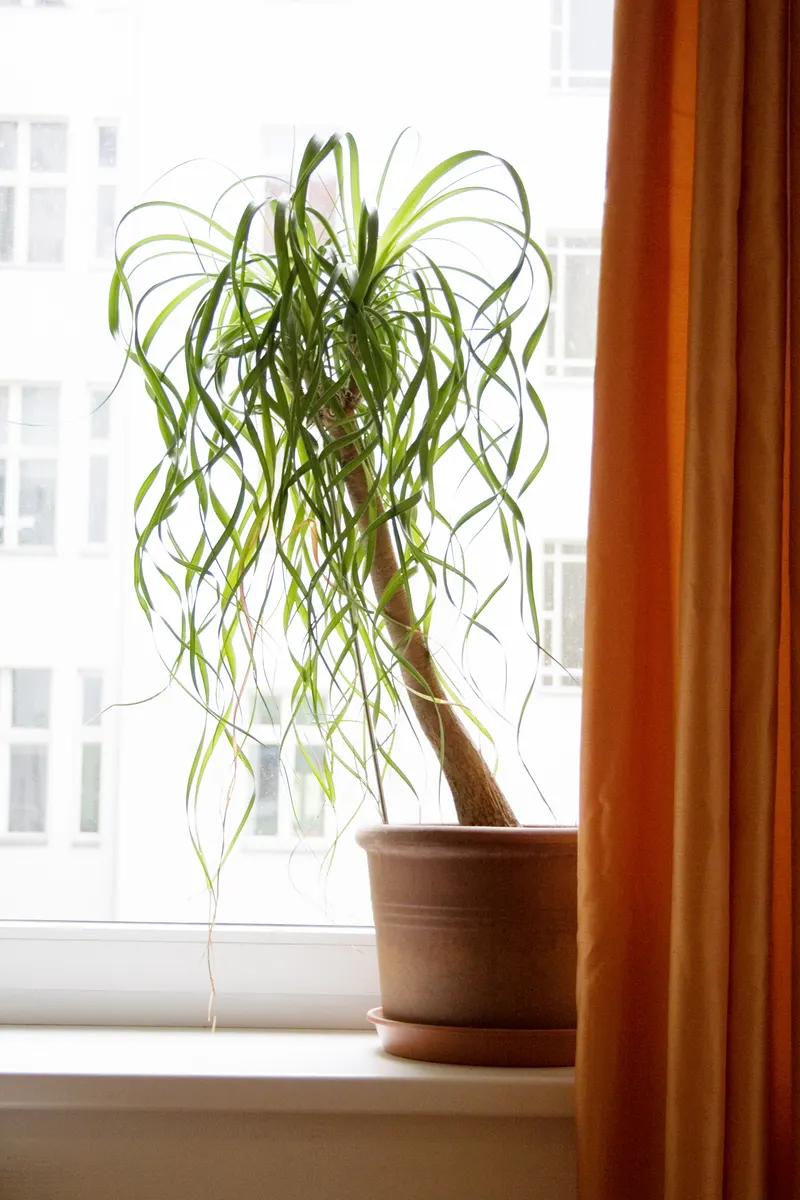
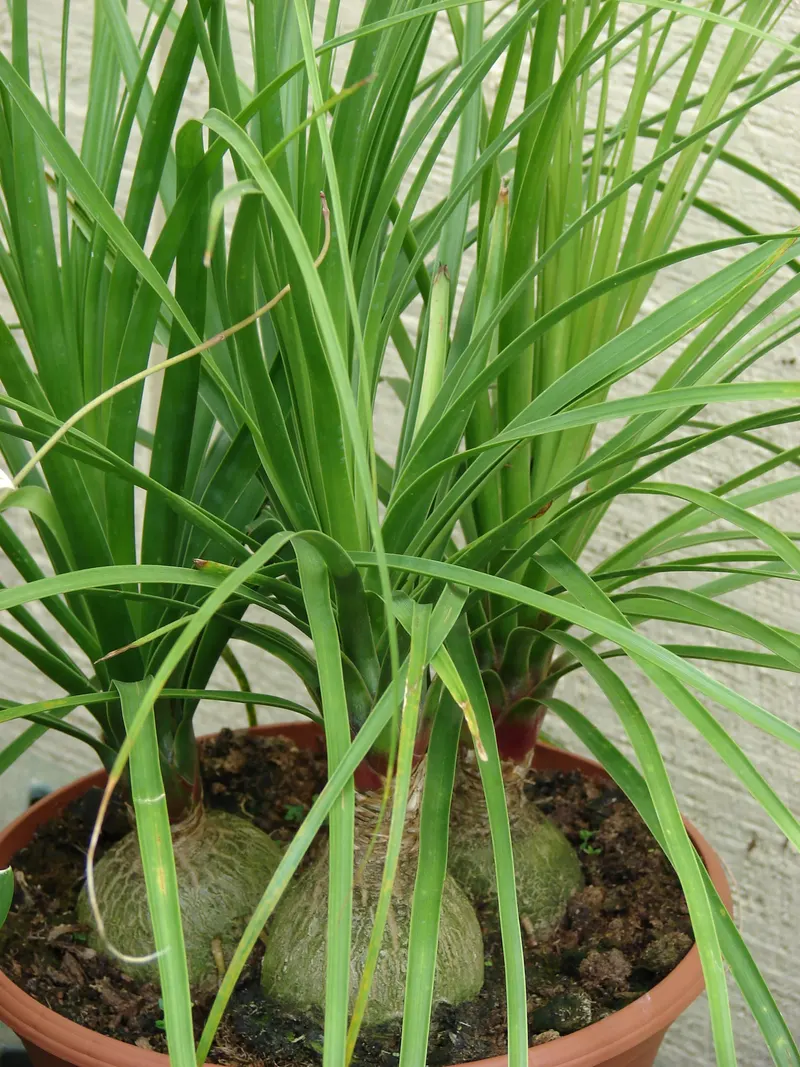
The ponytail palm is easy to care for and does well even for beginners1,2. In its thick stem base, the caudex, it stores water and so survives long dry spells2. Above it, the narrow leaves cascade down like a fountain1. Dry, heated air doesn't bother it3, and it lives so long that it can easily outlive you2.
Origin & history
In the wild it grows only in Mexico, in the Gulf, north-east and south-west regions4. There it grows on stony, poor soils in low, deciduous forests and reaches up to 9 m3.
An older name is Nolina recurvata5. Since 2017 it has been under international species protection (CITES, Appendix II)6.
Caution
The University of Nebraska–Lincoln lists the ponytail palm as non-toxic for people7; for cats and dogs it is considered non-toxic as well8,3. Careful when handling it, though: the leaf edges are finely serrated and can cut the skin2.
Care
Light. As bright as possible, ideally with direct sun2,3. A window with only morning or evening sun works too1. It can go outside in summer once nights stay above 10 °C, but get it used to the sun slowly, or it burns2,3.
Water. Water thoroughly and let the soil dry out in between, much less in winter2,3. Too much water is the most common reason it dies2.
Temperature & humidity. It likes dry winters and copes well with heated indoor air3,2; normal room temperature suits it9. It shouldn't get below 10 °C3,5.
Soil, pot & repotting. Cactus soil or potting compost with sharp sand or fine gravel2. A fairly small pot with good drainage is enough, and it also stays smaller in it2. You only need to repot it after many years2, then in spring5 – roughly every three to five years is a rule of thumb.
Feeding. Feeding once or twice per growing season is enough2; Iowa State suggests a dilute feed once or twice a month in spring and summer1.
Extras
Usually only large, old plants flower, and hardly ever indoors2,3. It is dioecious: only female plants bear seeds2. If you cut the top off young plants, they sprout several heads – that's how nurseries grow multi-headed specimens2.
Brown leaf tips are common indoors, caused by too much or too little water, too much fertiliser or built-up salts; you can cut them off2. Pests are rare, mostly mealybugs and scale insects2.

Symptoms & help
| too little | too much | |||
|---|---|---|---|---|
| Water | Leaf tips turn brown and dry. → Water thoroughly as soon as the soil has dried out. | Trunk and roots rot. → Let the soil dry out well, don't leave water in the cachepot. Water much less in winter. | ||
| Light | It grows weakly and the foliage turns yellowish-green. → Move it to the brightest window, ideally with direct sun. | Brown, burnt patches on the leaves. → After winter or before moving it outside, get it used to harsh sun slowly. | ||
| Fertiliser | Brown leaf tips. → Feed less often – once or twice a season is enough. | |||
| Warmth | Leaves droop, curl up and wilt. → Don't keep it below 10 °C, and only put it outside once nights stay above 10 °C. |
Take it with you
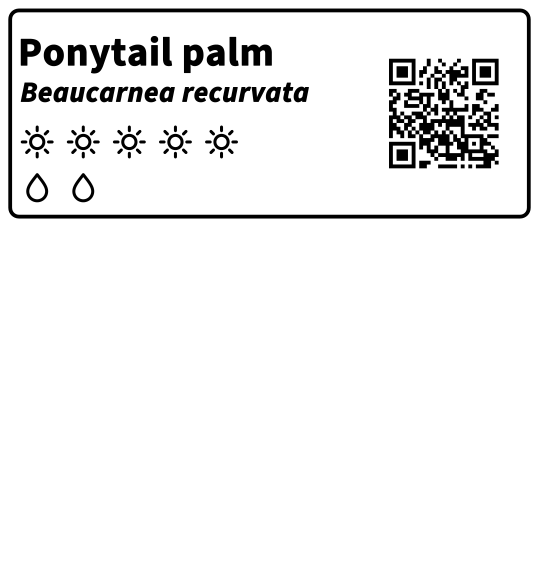
- Plant cardFront and back in A6 landscape – print it and keep it next to the pot
- PDF ↓
Notes on the files: Print & engrave
Licence and attribution for the plant labels: Readme (TXT)
Sources
- Iowa State University Extension and Outreach (2022): How do I care for a ponytail palm? Yard and Garden FAQ. https://yardandgarden.extension.iastate.edu/faq/how-do-i-care-ponytail-palm (accessed 14 October 2026)
- Mahr, S. & Mahr, D.: Ponytail Palm, Beaucarnea recurvata. University of Wisconsin–Madison, Division of Extension, Wisconsin Horticulture. https://hort.extension.wisc.edu/articles/ponytail-palm-beaucarnea-recurvata/ (accessed 14 October 2026)
- NC State Extension: Beaucarnea recurvata. North Carolina Extension Gardener Plant Toolbox. https://plants.ces.ncsu.edu/plants/beaucarnea-recurvata/ (accessed 14 October 2026)
- Royal Botanic Gardens, Kew: Beaucarnea recurvata (K.Koch & Fintelm.) Lem. Plants of the World Online. https://powo.science.kew.org/taxon/urn:lsid:ipni.org:names:531735-1 (accessed 14 October 2026)
- Royal Horticultural Society: Beaucarnea recurvata (elephant's foot). RHS Plants. https://www.rhs.org.uk/plants/1993/beaucarnea-recurvata/details (accessed 14 October 2026)
- UNEP-WCMC & CITES Secretariat: Beaucarnea recurvata – CITES Appendix II (since 2 January 2017). Species+. https://speciesplus.net/species#/taxon_concepts/68236/legal (accessed 14 October 2026)
- University of Nebraska–Lincoln Extension in Lancaster County (2015): Toxicity of Common Houseplants. Horticulture fact sheet 031 (archived copy). https://web.archive.org/web/20241123081117/https://lancaster.unl.edu/hort/factsheets/031_toxicityhouseplants.pdf (accessed 12 October 2026)
- ASPCA Animal Poison Control Center: Pony Tail (Beaucarnea recurvata). Toxic and Non-Toxic Plant List. https://www.aspca.org/pet-care/aspca-poison-control/toxic-and-non-toxic-plants/pony-tail (accessed 14 October 2026)
- DelPrince, J. M. & Perry, J. H. (2021): Care & Selection of Indoor Plants. Mississippi State University Extension, Publication 1012. https://extension.msstate.edu/publications/care-selection-indoor-plants (accessed 11 October 2026)
- Steil, A. (2024): Growing Succulents Indoors. Iowa State University Extension and Outreach, Yard and Garden. https://yardandgarden.extension.iastate.edu/how-to/growing-succulents-indoors (accessed 14 October 2026)
- Lüttge, U. (2004): Ecophysiology of Crassulacean Acid Metabolism (CAM). Annals of Botany 93, 629–652. doi:10.1093/aob/mch087
- Royal Horticultural Society: How to take cuttings from houseplants. RHS Growing Guide. https://www.rhs.org.uk/plants/types/houseplants/how-to-take-cuttings-from-houseplants (accessed 14 October 2026)