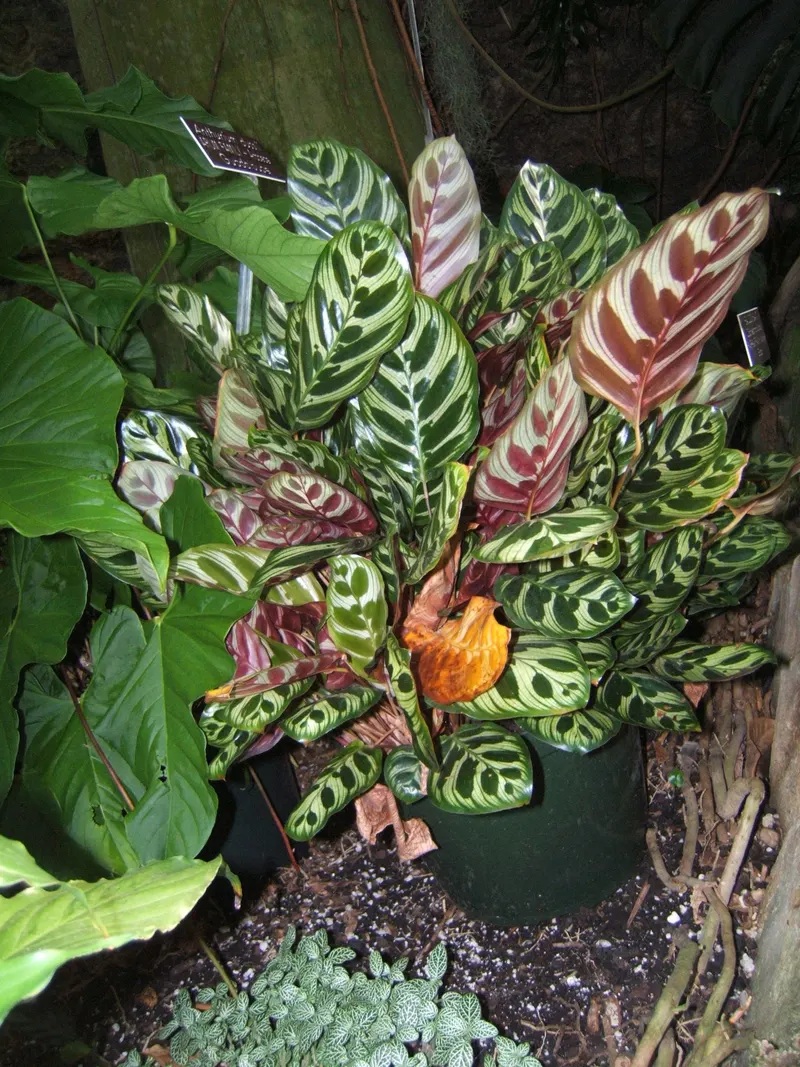
What it does for you
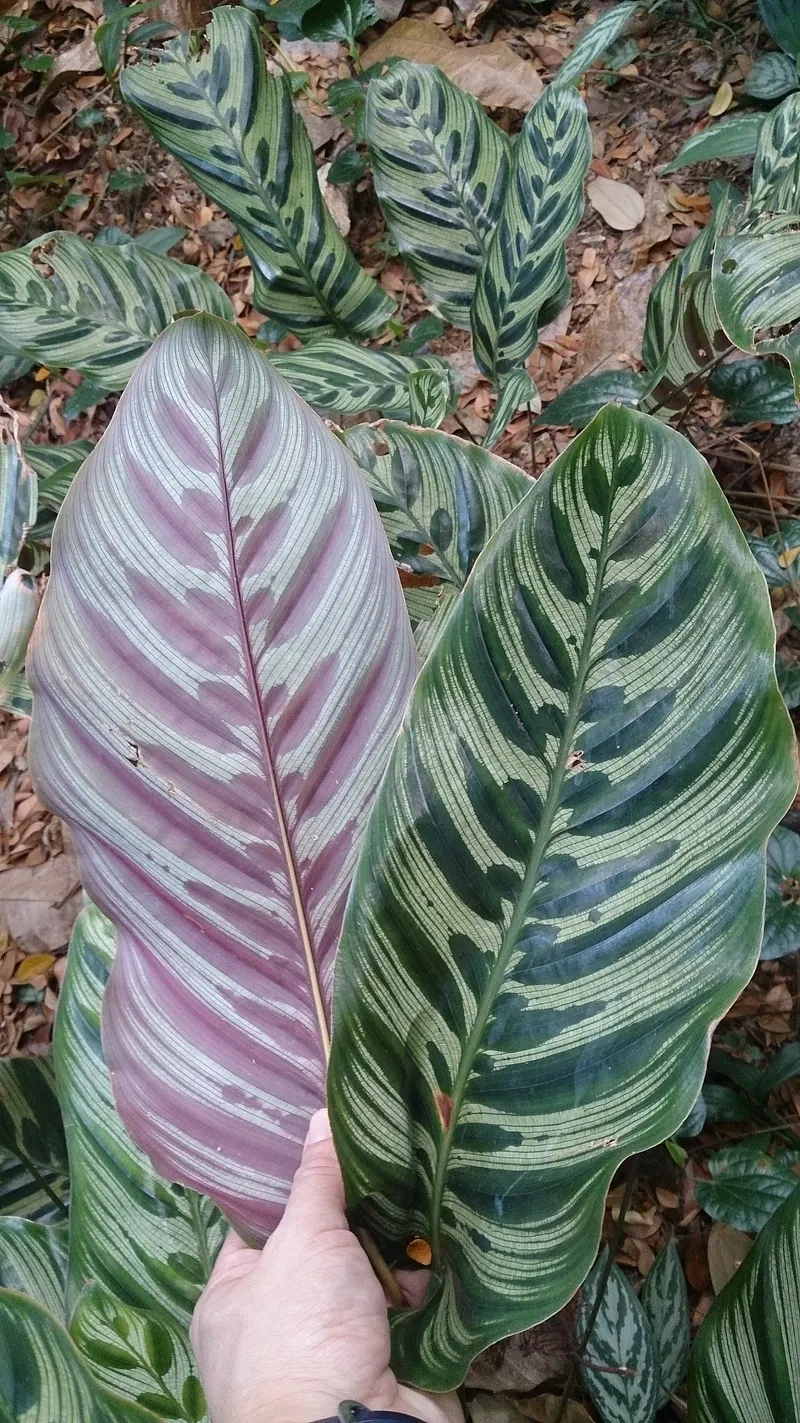
Its leaves look like peacock feathers: creamy white to light green with dark green blotches, the undersides reddish purple1. In the evening it folds its leaves upwards, at sunrise it opens them again1. This sleep movement is called nyctinasty2. And it's non-toxic for cats and dogs3.
Origin & history
Species from three genera are sold under the name "calathea"4. Which of them is the most common in shops isn't documented by any source we found. The RHS names the peacock plant, Goeppertia makoyana, as an example of a calathea with patterned leaves4; in the USA it was one of only three commonly grown species in 19755. That's the one this page is about. It grows wild in south-eastern Brazil, in Espírito Santo6, in warm, shady rainforest1.
It was described in 1872 as Calathea makoyana6, named after a nursery in Liège1. Since 2012 it has belonged to the genus Goeppertia7. In the trade it is often still called calathea2.
Caution
Good news: the calathea is non-toxic for cats and dogs3,1, and it's considered non-toxic for humans too8. Still, plants generally belong out of reach of small children8.
Care
Light. Bright, but out of direct sunlight. In summer a shady window or one with morning sun is ideal, in winter it can go to a sunny window4. If it's too dark, the pattern fades1.
Water. In spring and summer keep it evenly moist4; water when the surface has dried slightly5. In winter the surface may dry out, but never the whole soil4. Ideally use rainwater, because fluoride in tap water can turn the leaves brown1. The RHS considers tap water that has stood for a while to be fine4.
Temperature & humidity. 16–21 °C4 – NC State gives 18–24 °C1 – with no draughts or sudden temperature changes4,1. When it comes to humidity, it's a real diva: it needs about 60 percent1 – in heated rooms it's often only 10 to 309. A bright bathroom, a gravel tray or neighbouring plants help4, more on this in the basics.
Soil, pot & repotting. Peat-free houseplant soil or multipurpose compost with about ten percent grit. Repot in spring, once the clump fills the pot, and only one or two sizes bigger4 – depending on the source, every year to every few years4,2.
Feeding. From spring to early autumn once a month with liquid fertiliser, none in winter4. Too much fertiliser makes leaf tips die back5.
Extras
Indoors it rarely flowers; the flowers are small, white and purple1. Dust on the thin leaves slows down photosynthesis – wipe them now and then with a damp, soft cloth1. A relative, Calathea allouia, forms small tubers that are eaten like potatoes in the West Indies and northern South America5.

Symptoms & help
| too little | too much | |||
|---|---|---|---|---|
| Water | Leaves hang limp, curl up or turn yellow. → Water thoroughly and then keep the soil evenly moist – never let it dry out completely, even in winter. | Yellow leaves, water-soaked patches on the leaves, rotting roots or stems. → Water less often, empty the cachepot, let the surface dry out in winter; check the roots. | ||
| Light | Hardly grows, the leaf pattern fades. → Move it somewhere brighter, e.g. to a shady window or one with morning sun, in winter also to a sunny one. | Leaves turn yellowish or scorched. → Move it out of direct sun, somewhere bright and shaded. | ||
| Fertiliser | Leaves turn yellowish. → From spring to early autumn feed once a month with liquid fertiliser. | Leaf tips and edges turn brown and die back. → Feed less often or at a weaker dose. | ||
| Warmth | Leaves droop or curl – often after cold or draughts. → Move it somewhere warmer and draught-free, not below 16 °C, avoid sudden temperature changes. |
Take it with you
- Plant cardFront and back in A6 landscape – print it and keep it next to the pot
- PDF ↓

Notes on the files: Print & engrave
Licence and attribution for the plant labels: Readme (TXT)
Sources
- NC State Extension: Goeppertia makoyana. North Carolina Extension Gardener Plant Toolbox. https://plants.ces.ncsu.edu/plants/goeppertia-makoyana/ (accessed 12 October 2026)
- NC State Extension: Goeppertia. North Carolina Extension Gardener Plant Toolbox. https://plants.ces.ncsu.edu/plants/goeppertia/ (accessed 12 October 2026)
- ASPCA Animal Poison Control Center: Calathea (Calathea spp.). Toxic and Non-Toxic Plant List. https://www.aspca.org/pet-care/aspca-poison-control/toxic-and-non-toxic-plants/calathea (accessed 12 October 2026)
- Royal Horticultural Society: How to grow calatheas. RHS Growing Guides. https://www.rhs.org.uk/plants/calathea/growing-guide (accessed 12 October 2026)
- Chen, J. & McConnell, D. B. (2006): Cultural Guidelines for Commercial Production of Interiorscape Calathea. UF/IFAS Extension, ENH1030/EP285 (reviewed 2024). https://edis.ifas.ufl.edu/publication/EP285 (accessed 12 October 2026)
- Royal Botanic Gardens, Kew: Goeppertia makoyana (É.Morren) Borchs. & S.Suárez. Plants of the World Online. https://powo.science.kew.org/taxon/urn:lsid:ipni.org:names:60461041-2 (accessed 12 October 2026)
- Borchsenius, F., Suárez Suárez, L. S. & Prince, L. M. (2012): Molecular Phylogeny and Redefined Generic Limits of Calathea (Marantaceae). Systematic Botany 37(3), 620–635. doi:10.1600/036364412X648571
- University of Nebraska–Lincoln Extension in Lancaster County (2015): Toxicity of Common Houseplants. Horticulture fact sheet 031 (archived copy). https://web.archive.org/web/20241123081117/https://lancaster.unl.edu/hort/factsheets/031_toxicityhouseplants.pdf (accessed 12 October 2026)
- DelPrince, J. M. & Perry, J. H. (2021): Care & Selection of Indoor Plants. Mississippi State University Extension, Publication 1012. https://extension.msstate.edu/publications/care-selection-indoor-plants (accessed 11 October 2026)
- Missouri Botanical Garden: Calathea makoyana. Plant Finder. https://www.missouribotanicalgarden.org/PlantFinder/PlantFinderDetails.aspx?taxonid=244440 (accessed 12 October 2026)
- Berger, J., Essah, E. & Blanuša, T. (2024): The impact of plants on the humidity of naturally-ventilated office indoor environments. Journal of Building Engineering 86, 108814. doi:10.1016/j.jobe.2024.108814
- Royal Horticultural Society: How to take cuttings from houseplants. RHS Growing Guide. https://www.rhs.org.uk/plants/types/houseplants/how-to-take-cuttings-from-houseplants (accessed 14 October 2026)