What it does for you
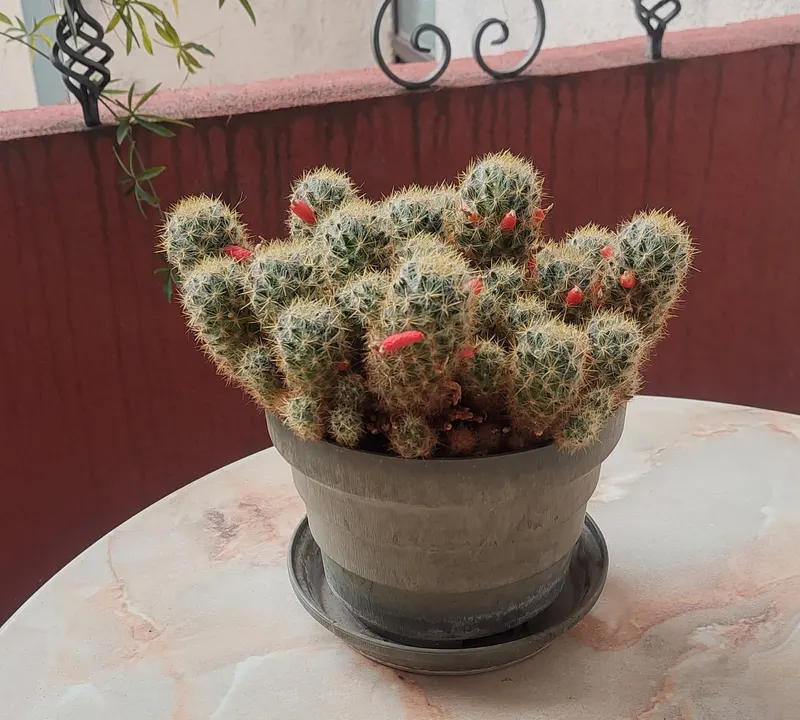
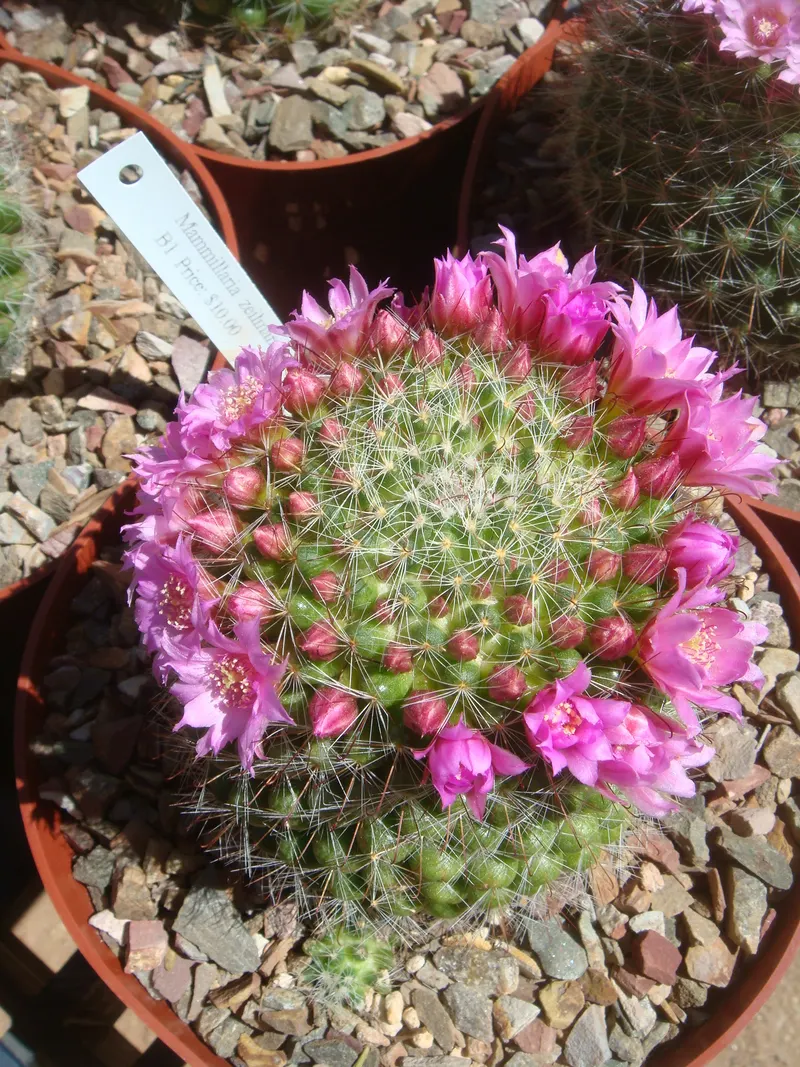
Pincushion cacti stay small – popular species such as M. zeilmanniana and M. elongata only grow 10 to 15 cm tall1,2 – and fit on any sunny windowsill. Their funnel-shaped flowers usually appear as a ring around the crown1, white, yellow, pink or red depending on the species3. Dry, heated air doesn't bother them4, and they are considered non-toxic3.
Origin & history
In the wild, pincushion cacti grow from the southern USA through Mexico and Central America to Colombia and Venezuela, and on many Caribbean islands8. The name comes from the Latin mammilla, "nipple" – meaning the tubercles that cover the body3.
The genus has around 150 species3, and many of them are sold in shops: the pink-flowering M. zeilmanniana, say, M. plumosa wrapped in white spines, or M. elongata with finger-shaped stems. They're all cared for the same way1,9,2.
Caution
Pincushion cacti are considered non-toxic for people3; the ASPCA lists M. fragilis as non-toxic for cats and dogs10. The spines can hurt you, though3. To handle them, use an oven glove or a strip of folded newspaper4.
Care
Light. Full sun, on a sunny windowsill all year round4,1. In high summer it tolerates a little afternoon shade3.
Water. In spring and summer, water thoroughly once the soil is dry and let the water drain away3,4. From late autumn to early spring, give only enough to keep it from shrivelling. Rainwater is best4.
Temperature & humidity. Warm in summer, around 21–27 °C3, cool in winter at 8–10 °C at night4. It can't take frost1. Dry air suits it fine4.
Soil, pot & repotting. Peat-free cactus soil in a pot that isn't too big – otherwise the soil stays wet for too long4. Shallow clay pots dry out faster11. Repot every two to three years in spring3,4.
Feeding. From spring to early autumn once a month with cactus fertiliser or a potassium-rich liquid feed such as tomato fertiliser4.
Extras
A cool, almost dry winter rest and as much light as possible all year help it to flower4. This is exactly where it's the opposite of the Christmas cactus: that one comes from the rainforest, flowers in winter and then wants regular water4.
The most common pests are mealybugs1,3.

Symptoms & help
| too little | too much | |||
|---|---|---|---|---|
| Water | The body shrivels, hardly grows or becomes misshapen. → In spring and summer, water thoroughly as soon as the soil is dry. In winter only if it shrivels. | Soft, rotting patches, blisters on the skin, hardly any growth. → Let the soil dry out completely, don't leave water in the cachepot. Keep it almost dry in winter. | ||
| Light | It grows weak and misshapen and hardly flowers. → Move it to the brightest, sunniest window and get it used to the sun slowly. | Brown patches on the skin that shrink and scab over (corky scab). → Change conditions slowly – shade it in the afternoon on hot days. | ||
| Fertiliser | Hardly any growth in summer and few flowers. → From spring to early autumn, feed once a month with cactus fertiliser or a potassium-rich liquid feed. | |||
| Warmth | Discoloured patches on the skin, parts die off. → Keep it frost-free and above 5 °C. In winter cool but dry – about 8–10 °C at night. |
Take it with you
- Plant cardFront and back in A6 landscape – print it and keep it next to the pot
- PDF ↓

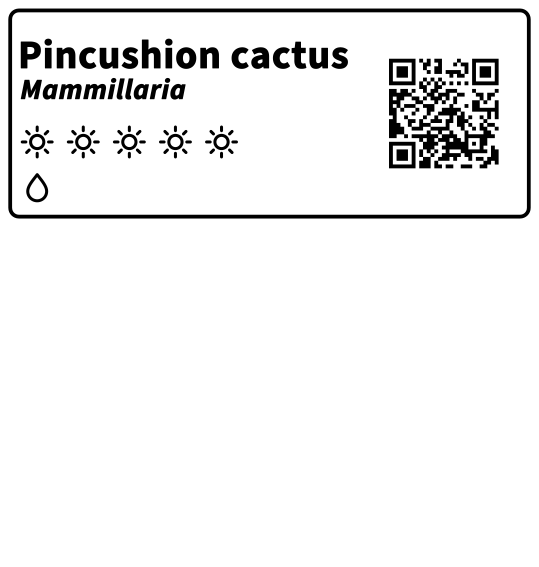
Notes on the files: Print & engrave
Licence and attribution for the plant labels: Readme (TXT)
Sources
- Royal Horticultural Society: Mammillaria zeilmanniana (rose pincushion). RHS Plants. https://www.rhs.org.uk/plants/106181/mammillaria-zeilmanniana/details (accessed 14 October 2026)
- Royal Horticultural Society: Mammillaria elongata (ladyfinger cactus). RHS Plants. https://www.rhs.org.uk/plants/10815/mammillaria-elongata/details (accessed 14 October 2026)
- NC State Extension: Mammillaria. North Carolina Extension Gardener Plant Toolbox. https://plants.ces.ncsu.edu/plants/mammillaria/ (accessed 14 October 2026)
- Royal Horticultural Society: How to grow houseplant cacti and succulents. RHS Growing Guide. https://www.rhs.org.uk/plants/types/cacti-succulents/houseplants/growing-guide (accessed 14 October 2026)
- Son, K.-C., Ryu, M.-H. & Park, W.-K. (1999): Effects of Cacti on the Protection against Low Frequency Electromagnetic Waves Radiated from Computer Monitor. Horticultural Science & Technology 17(6), 773–776. https://koreascience.kr/article/JAKO199928066987548.page (accessed 14 October 2026)
- Calp, M. H., Topaloğlu, N., Erensayın, E. & Savaş, S. (2019): Effect of Cactus Plants on Magnetic Fields Bruited by Computer Screens. Gümüşhane Üniversitesi Fen Bilimleri Enstitüsü Dergisi 9, 70–79. doi:10.17714/gumusfenbil.393173
- Cummings, B. E. & Waring, M. S. (2020): Potted plants do not improve indoor air quality: a review and analysis of reported VOC removal efficiencies. Journal of Exposure Science & Environmental Epidemiology 30, 253–261. doi:10.1038/s41370-019-0175-9
- Royal Botanic Gardens, Kew: Mammillaria Haw. Plants of the World Online. https://powo.science.kew.org/taxon/urn:lsid:ipni.org:names:331750-2 (accessed 14 October 2026)
- Royal Horticultural Society: Mammillaria plumosa (feather cactus). RHS Plants. https://www.rhs.org.uk/plants/10832/mammillaria-plumosa/details (accessed 14 October 2026)
- ASPCA Animal Poison Control Center: Thimble Cactus (Mammillaria fragilis). Toxic and Non-Toxic Plant List. https://www.aspca.org/pet-care/aspca-poison-control/toxic-and-non-toxic-plants/thimble-cactus (accessed 14 October 2026)
- Steil, A. (2024): Growing Succulents Indoors. Iowa State University Extension and Outreach, Yard and Garden. https://yardandgarden.extension.iastate.edu/how-to/growing-succulents-indoors (accessed 14 October 2026)
- Lüttge, U. (2004): Ecophysiology of Crassulacean Acid Metabolism (CAM). Annals of Botany 93, 629–652. doi:10.1093/aob/mch087
- Royal Horticultural Society: How to take cuttings from houseplants. RHS Growing Guide. https://www.rhs.org.uk/plants/types/houseplants/how-to-take-cuttings-from-houseplants (accessed 14 October 2026)