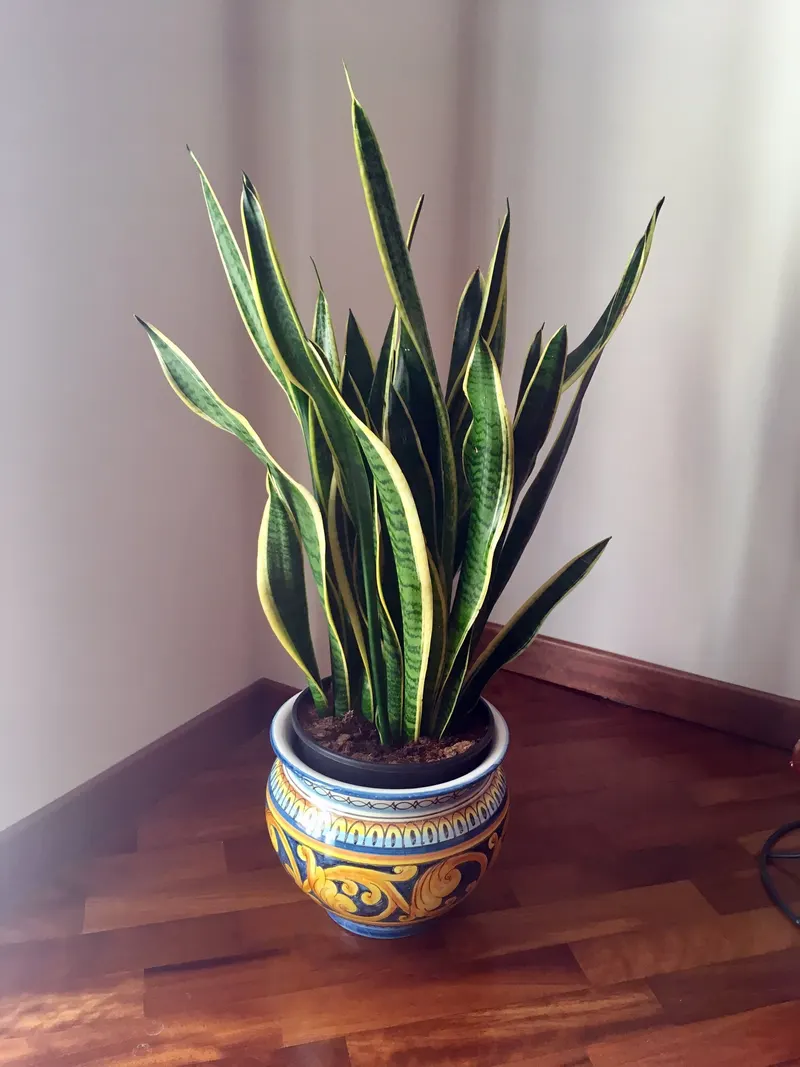
What it does for you
The snake plant is a succulent: it stores water in its thick leaves and uses CAM photosynthesis – it opens its stomata mainly at night and so loses hardly any water during the day1. For you, that means: it forgives forgotten watering like hardly any other plant. For the same reason, though, it adds hardly anything to the humidity2.
What it really can do: make your home greener and cosier. Just handling houseplants – repotting, say – lowered stress markers such as diastolic blood pressure and sympathetic nerve activity in one small study3.
Origin & history
The snake plant comes from tropical West and Central Africa – from Nigeria via Cameroon and Gabon to the Congo, with scattered occurrences as far as Tanzania6. Its relatives there live in habitats ranging from dry areas with less than 250 millimetres of rain a year to humid forests7.
For decades it was called Sansevieria trifasciata. Since DNA analyses showed that the sansevierias are nested right within the dragon trees (Dracaena), its official name is Dracaena trifasciata8. And why is it also called bowstring hemp? In Africa and India, the tough leaf fibres of various sansevierias were made into bowstrings, cords and mats; in the Second World War the USA even tested the snake plant as a substitute for sisal7.
Caution
The snake plant contains saponins. For cats and dogs it is toxic: if they nibble on it, it can lead to nausea, vomiting and diarrhoea9. The RHS calls it poisonous and advises keeping it out of reach of children and pets. The sap can irritate the skin – best wear gloves when dividing or cutting10.
Care
Light. Ideally bright, without harsh midday sun in summer. In darker corners it grows only very slowly10.
Water. Better too little than too much: only water once the soil has dried out completely (finger test all the way down) – as a rule of thumb every two to three weeks in summer, often only once a month in winter. Water onto the soil, not into the leaf rosette, and tip away water in the cachepot to avoid waterlogging.
Temperature & humidity. 15–24 °C is ideal10; the RHS gives a minimum of 5–10 °C, so to be safe keep it above 10 °C11. Dry, heated air doesn't bother it – don't mist.
Soil, pot & repotting. Free-draining cactus soil, or houseplant soil with a third sand or grit10. As a rule of thumb, a heavy pot with a drainage hole stops the tall leaves from tipping everything over. Clay works well: the soil dries faster in it12. Repot only when roots fill the pot, into a pot just slightly bigger10 – as a rule of thumb every two to four years in spring.
Feeding. From spring to early autumn about once a month with a liquid houseplant or cactus fertiliser10; as a rule of thumb not at all in winter.
Extras
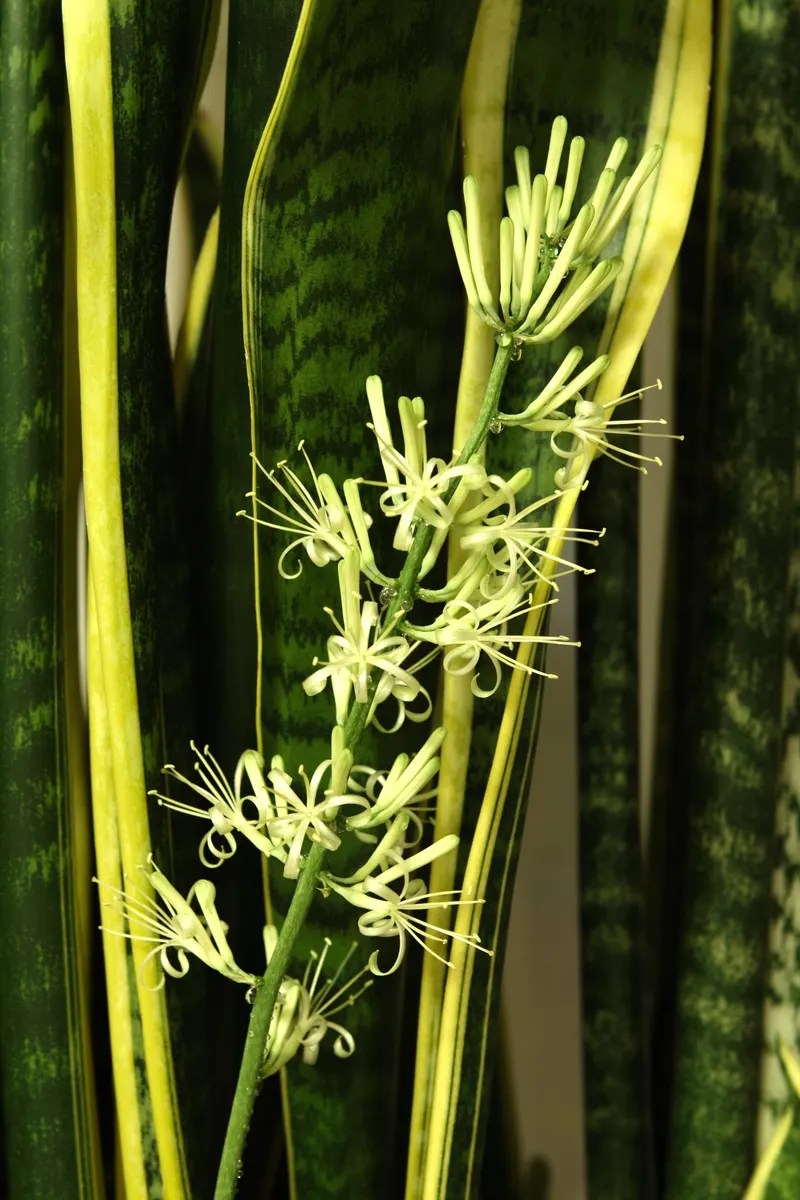
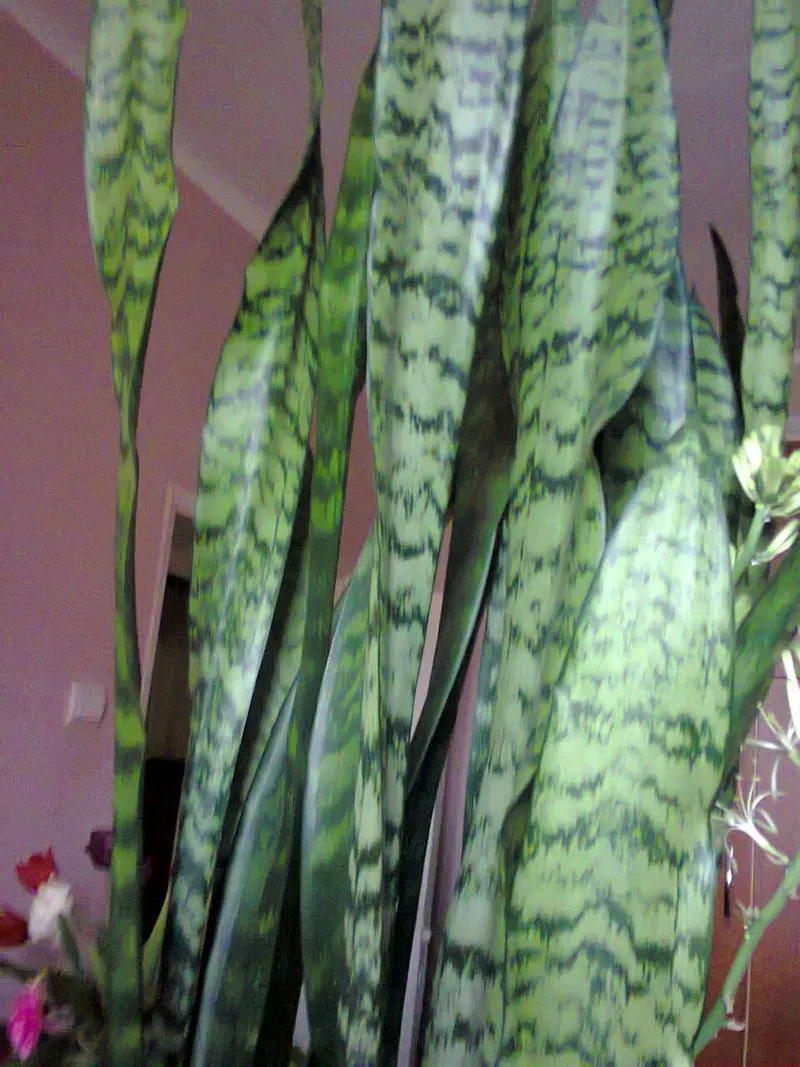
Sometimes it flowers: on a long stalk, greenish-white flowers open and start to smell sweet towards evening7.


Symptoms & help
| too little | too much | |||
|---|---|---|---|---|
| Water | Leaves wrinkle, the lower ones dry up. → Water thoroughly, pour off the excess after 15 minutes. | Leaves soft or yellow, the plant leans or wobbles; the soil stays wet. → Take it out of the pot, cut off rotten parts, replant in fresh, dry cactus soil and don't water until the soil has dried out. | ||
| Light | Hardly any new leaves; leaves grow long and thin and flop over, the colour turns pale. → Move it closer to the window and water even more sparingly. | Pale yellow to brown, dry patches on the sunny side. → Move it out of the midday sun, get it used to more sun gradually. Burnt patches stay. | ||
| Warmth | Damaged leaves – often after a night at a cold window or in a draught. → Move it somewhere warmer, keep it dry, cut badly damaged leaves off at the base. |
Take it with you
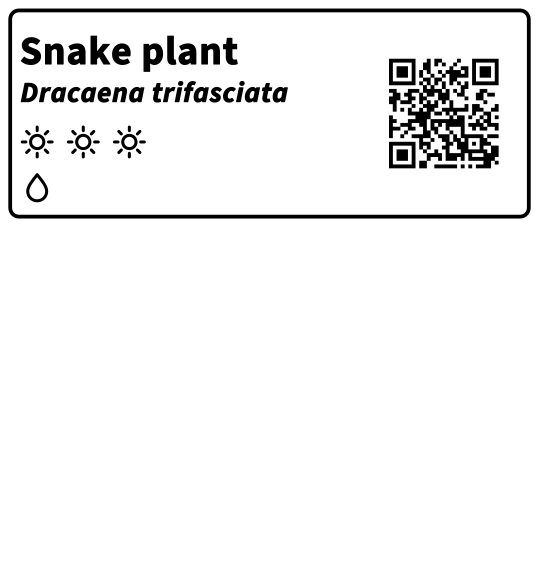
- Plant cardFront and back in A6 landscape – print it and keep it next to the pot
- PDF ↓
Notes on the files: Print & engrave
Licence and attribution for the plant labels: Readme (TXT)
Sources
- Lüttge, U. (2004): Ecophysiology of Crassulacean Acid Metabolism (CAM). Annals of Botany 93, 629–652. doi:10.1093/aob/mch087
- Berger, J., Essah, E. & Blanuša, T. (2024): The impact of plants on the humidity of naturally-ventilated office indoor environments. Journal of Building Engineering 86, 108814. doi:10.1016/j.jobe.2024.108814
- Lee, M., Lee, J., Park, B.-J. & Miyazaki, Y. (2015): Interaction with indoor plants may reduce psychological and physiological stress by suppressing autonomic nervous system activity in young adults: a randomized crossover study. Journal of Physiological Anthropology 34, 21. doi:10.1186/s40101-015-0060-8
- Wolverton, B. C., Johnson, A. & Bounds, K. (1989): Interior Landscape Plants for Indoor Air Pollution Abatement. NASA Technical Memorandum TM-101766. https://ntrs.nasa.gov/citations/19930073077
- Cummings, B. E. & Waring, M. S. (2020): Potted plants do not improve indoor air quality: a review and analysis of reported VOC removal efficiencies. Journal of Exposure Science & Environmental Epidemiology 30, 253–261. doi:10.1038/s41370-019-0175-9
- Royal Botanic Gardens, Kew: Dracaena trifasciata (Prain) Mabb. Plants of the World Online. https://powo.science.kew.org/taxon/urn:lsid:ipni.org:names:77164235-1 (accessed 11 October 2026)
- PROSEA (Plant Resources of South-East Asia): Sansevieria Thunb. PROSEA 17: Fibre plants, via Pl@ntUse. https://uses.plantnet-project.org/en/Sansevieria_Thunb._(PROSEA) (accessed 11 October 2026)
- Takawira-Nyenya, R., Mucina, L., Cardinal-McTeague, W. M. & Thiele, K. R. (2018): Sansevieria (Asparagaceae, Nolinoideae) is a herbaceous clade within Dracaena. Phytotaxa 376(6), 254–276. doi:10.11646/phytotaxa.376.6.2
- ASPCA Animal Poison Control Center: Snake Plant (Sansevieria trifasciata). Toxic and Non-Toxic Plant List. https://www.aspca.org/pet-care/animal-poison-control/toxic-and-non-toxic-plants/snake-plant (accessed 11 October 2026)
- Royal Horticultural Society: How to grow sansevieria. RHS Growing Guides. https://www.rhs.org.uk/plants/sansevieria/growing-guide (accessed 11 October 2026)
- Royal Horticultural Society: Sansevieria trifasciata (mother-in-law's tongue). RHS Plants. https://www.rhs.org.uk/plants/16430/sansevieria-trifasciata/details (accessed 12 October 2026)
- Steil, A. (2024): Growing Succulents Indoors. Iowa State University Extension and Outreach, Yard and Garden. https://yardandgarden.extension.iastate.edu/how-to/growing-succulents-indoors (accessed 14 October 2026)
- Missouri Botanical Garden: Dracaena trifasciata. Plant Finder. https://www.missouribotanicalgarden.org/PlantFinder/PlantFinderDetails.aspx?kempercode=b617 (accessed 12 October 2026)
- Royal Horticultural Society: How to take cuttings from houseplants. RHS Growing Guide. https://www.rhs.org.uk/plants/types/houseplants/how-to-take-cuttings-from-houseplants (accessed 14 October 2026)
- DelPrince, J. M. & Perry, J. H. (2021): Care & Selection of Indoor Plants. Mississippi State University Extension, Publication 1012. https://extension.msstate.edu/publications/care-selection-indoor-plants (accessed 11 October 2026)
- Royal Horticultural Society: Palms: indoors. RHS Advice. https://www.rhs.org.uk/plants/types/trees/indoor-palms (accessed 12 October 2026)