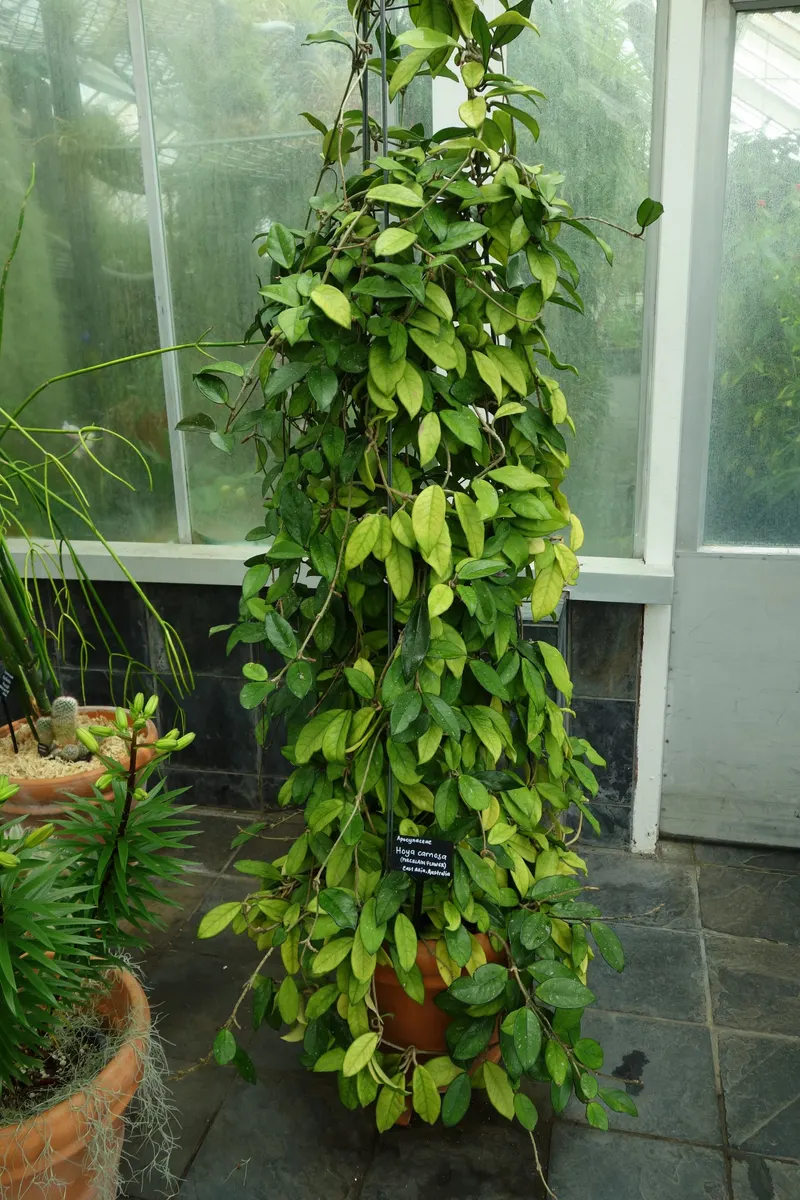
What it does for you
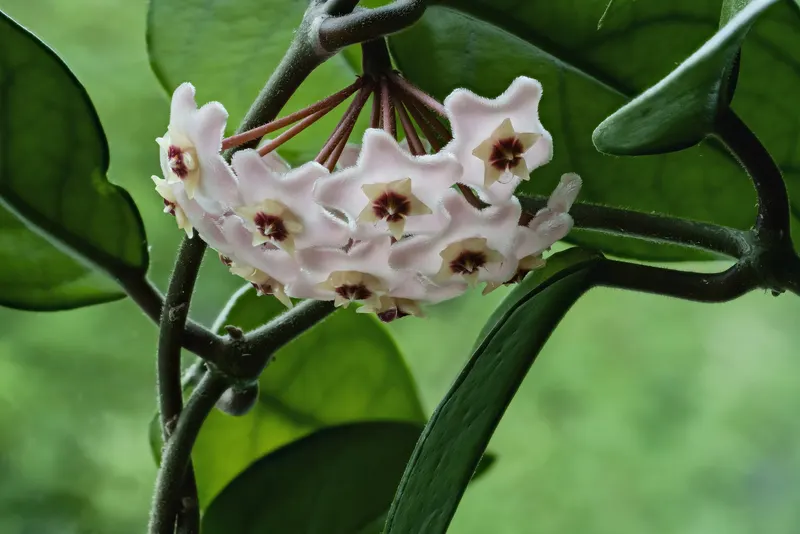
Its small, star-shaped flowers are shiny and waxy, held in domed clusters, and highly fragrant, especially at night1. The thick, semi-succulent leaves can store water1. MBG calls it a long-lived houseplant2. It doesn't measurably clean the air: depending on the study, you'd need ten to a thousand plants per square metre3.
Origin & history
In the wild it grows from southern China to Laos and from southern Japan to Taiwan, as a climbing epiphyte or on rocks, mainly in the subtropics5. It was first published in 1782 as Asclepias carnosa, and as Hoya carnosa in 18105.
The genus honours Thomas Hoy, gardener to the Duke of Northumberland in the late 18th century2. Carnosa means fleshy, after the thick leaves4.
Caution
Sources differ. The ASPCA lists it, under the cultivar 'Krinkle Kurl', as non-toxic for cats and dogs6, and a University of Nebraska Extension list calls hoyas non-toxic7. The University of Zurich's veterinary toxicology database rates the whole plant as very highly toxic in exceptional cases8. The main compounds in hoyas are pregnanes and pregnane glycosides, some of which presumably act like heart glycosides. The database rates hoyas as very highly toxic for birds and calls them a dangerous plant for pet birds; in dogs and cats only stomach and gut symptoms have been seen so far9. We found no rating by a poison centre for people. The RHS calls the milky sap toxic and advises gloves, as it can irritate the skin1.
Care
The RHS guide covers hoyas in general; its winter minimum is for this species.
Light. A bright spot, but out of hot summer sun, which can scorch the leaves1. MBG advises at least half a day of direct sun, NC State bright indirect light2,4. Good light is needed for flowers; once buds appear, don't move or turn the pot2.
Water. From spring to autumn water regularly; keep the compost moist but not waterlogged, or the roots may rot. From mid-autumn to late winter wait until it is fairly dry, but never let it dry out completely1. NC State says to let the soil dry between waterings and to use water at room temperature4. As a rule of thumb, about once a week in summer.
Temperature & humidity. 16–24 °C in spring and summer, away from radiators and cold draughts; cooler in winter, at least 10 °C at night. It dislikes dry air while growing: stand it on a saucer of damp gravel1. Spider mites can appear when the air is too dry4.
Soil, pot & repotting. A sharply draining mix, such as equal parts orchid bark, peat-free multi-purpose compost and coarse perlite. It can stay in its pot for several years, until the roots fill it; repot in spring into a pot only a few centimetres larger1. It doesn't mind being pot-bound – just don't repot it while it is in bud or flower4.
Feeding. Lightly: every couple of weeks in spring and summer, ideally with an orchid feed, once a month in autumn and winter. Flush the pot with plain water every few months to prevent a build-up of salts1.
Extras
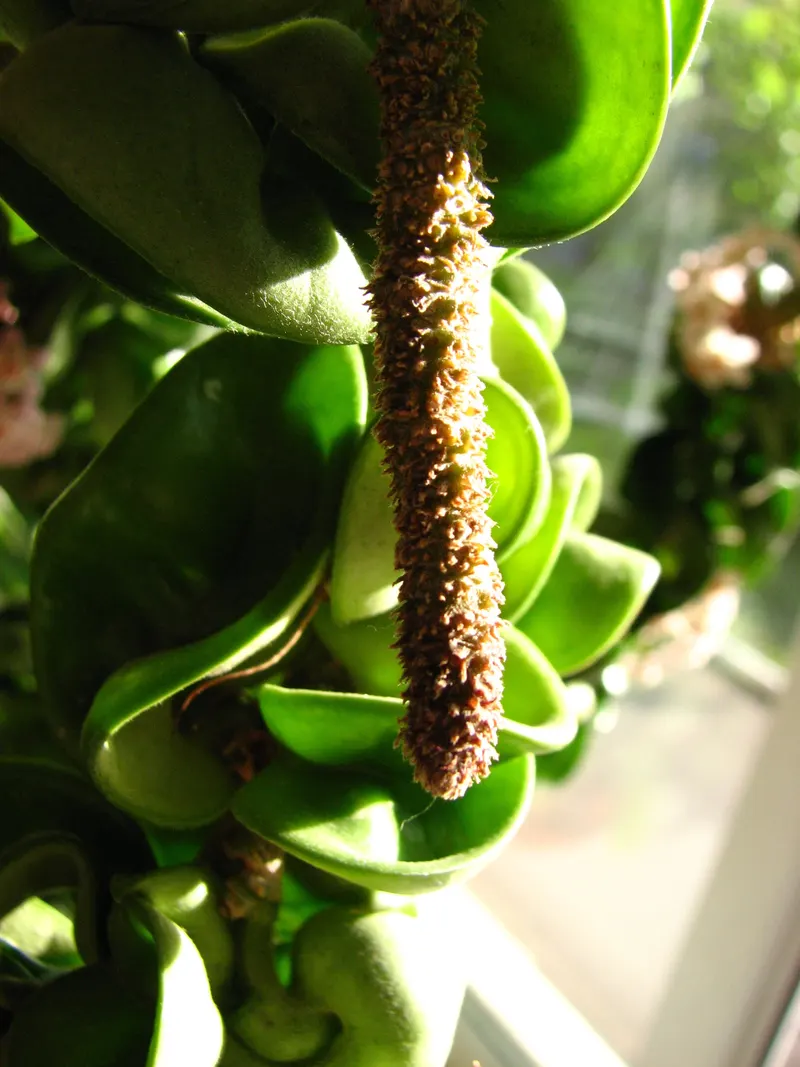
The flowers are white to pink and hairy, in clusters of up to 304, and they make sticky nectar8. Cultivars include 'Krimson Queen' or 'Tricolor', with creamy white to pink margins, and 'Compacta' or 'Krinkle Kurl', with folded, rope-like leaves4.


Symptoms & help
| too little | too much | |||
|---|---|---|---|---|
| Water | Leaves or flower buds drop. → Water regularly from spring to autumn; in winter never let the compost dry out completely. | Leaves drop or turn black, dieback; the roots rot. → Always let the water drain away and water less. With root rot it rarely recovers – take cuttings straight away. | ||
| Light | It doesn't flower. → Move it somewhere brighter with some sun, but out of hot summer sun. | Scorched leaves. → Move it out of hot summer sun. | ||
| Fertiliser | Stems wilt and die back. → Flush the pot with plain water and feed only lightly. | |||
| Warmth | Leaves drop or turn black, dieback. → In winter keep it at 10 °C or more at night, away from cold draughts. |
Take it with you
- Plant cardFront and back in A6 landscape – print it and keep it next to the pot
- PDF ↓
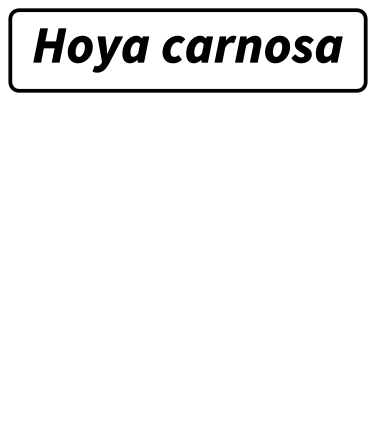
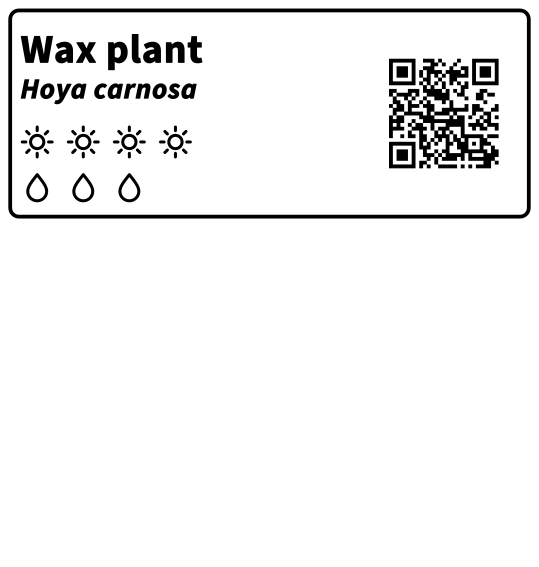
Notes on the files: Print & engrave
Licence and attribution for the plant labels: Readme (TXT)
Sources
- Royal Horticultural Society: How to grow hoya. RHS Growing Guide. https://www.rhs.org.uk/plants/hoya/growing-guide (accessed 20 October 2026)
- Missouri Botanical Garden: Hoya carnosa. Plant Finder. https://www.missouribotanicalgarden.org/PlantFinder/PlantFinderDetails.aspx?kempercode=b537 (accessed 20 October 2026)
- Cummings, B. E. & Waring, M. S. (2020): Potted plants do not improve indoor air quality: a review and analysis of reported VOC removal efficiencies. Journal of Exposure Science & Environmental Epidemiology 30, 253–261. doi:10.1038/s41370-019-0175-9
- North Carolina State Extension: Hoya carnosa. North Carolina Extension Gardener Plant Toolbox. https://plants.ces.ncsu.edu/plants/hoya-carnosa/ (accessed 20 October 2026)
- Royal Botanic Gardens, Kew: Hoya carnosa (L.f.) R.Br. Plants of the World Online. https://powo.science.kew.org/taxon/urn:lsid:ipni.org:names:107308-3 (accessed 20 October 2026)
- ASPCA Animal Poison Control Center: Wax Plant (Hoya carnosa 'krinkle kurl'). Toxic and Non-Toxic Plant List. https://www.aspca.org/pet-care/aspca-poison-control/toxic-and-non-toxic-plants/wax-plant (accessed 20 October 2026)
- University of Nebraska–Lincoln Extension in Lancaster County (2015): Toxicity of Common Houseplants. Horticulture fact sheet 031 (archived copy). https://web.archive.org/web/20241123081117/https://lancaster.unl.edu/hort/factsheets/031_toxicityhouseplants.pdf (accessed 12 October 2026)
- Institut für Veterinärpharmakologie und -toxikologie, Universität Zürich: Hoya carnosa. Arznei- und Giftpflanzen (CliniTox). https://www.vetpharm.uzh.ch/giftdb/pflanzen/0228_bot.htm (accessed 20 October 2026)
- Institut für Veterinärpharmakologie und -toxikologie, Universität Zürich: Hoya sp. CliniTox Pflanzengifte. https://www.vetpharm.uzh.ch/giftdb/pflanzen/0228_tox.htm (accessed 20 October 2026)
- Royal Horticultural Society: Hoya carnosa. RHS Find a Plant. https://www.rhs.org.uk/plants/8852/hoya-carnosa/details (accessed 20 October 2026)
- Singh, B. K., Greenberg, E. & Preiss, J. (1984): ADPglucose Pyrophosphorylase from the CAM Plants Hoya carnosa and Xerosicyos danguyi. Plant Physiology 74 (3), 711–716. doi:10.1104/pp.74.3.711
- Lüttge, U. (2004): Ecophysiology of Crassulacean Acid Metabolism (CAM). Annals of Botany 93, 629–652. doi:10.1093/aob/mch087
- Royal Horticultural Society: How to take cuttings from houseplants. RHS Growing Guide. https://www.rhs.org.uk/plants/types/houseplants/how-to-take-cuttings-from-houseplants (accessed 14 October 2026)
- DelPrince, J. M. & Perry, J. H. (2021): Care & Selection of Indoor Plants. Mississippi State University Extension, Publication 1012. https://extension.msstate.edu/publications/care-selection-indoor-plants (accessed 11 October 2026)
- Royal Horticultural Society: Palms: indoors. RHS Advice. https://www.rhs.org.uk/plants/types/trees/indoor-palms (accessed 12 October 2026)